
For four centuries, the natives of North America and the European invaders murdered each other. Spicers managed to be among the final victims.
The Sioux
Before Custer lost his men and his scalp at the Battle of Little Big Horn in 1876, the Great Sioux Reservation covered land in what would become seven states. The Sioux were divided into Dakota and Lakota tribes, and lived by following the buffalo. A traveller wrote about his journey in 1877, and the immensity of the herds:
One herd we passed through, traveling for three days without being out of sight of bison during daylight, numbered far up into the hundred thousands. When we had passed through this herd at the close of the third day, the scouts reported another tremendous herd in the distance, coming directly toward us at full speed. Quickly our party sought the protection of the neighboring buttes, while a few of us climbed a rocky eminence on the open prairie, and awaited with interest the approach of the rushing mass. On they came, helter skelter, pell mell, and when the leaders reached the hillock upon which we were perched, the great herd divided into two parts and swept by us like the wind, half on either side. We gazed in wonder and awe at the sea of black shaggy life rolling like billows at our feet. Far as the eye could see was an ocean of buffaloes, surging and swaying like the waves, while the awful rumbling sound and shaking of the earth made our heads a little dizzy. All that afternoon the animals kept up their flight, and it was not until the sun sank behind the tall mountains that their numbers began to lessen and left us free to escape from our temporary prison. [This] herd, which was moving at high speed, was packed so thick that I believe it contained fully as many animals as the first herd. They flew by us for five hours on a dead run, and the horizon of our sight was bounded by nothing but the dark black hides of the noble animals themselves.
When the Indians were captured and corralled upon reservations, it left the bison to the mercy of white hunters and deadly repeating rifles, and the two together have done the business for them.
Hamilton Spectator, May 28 1885

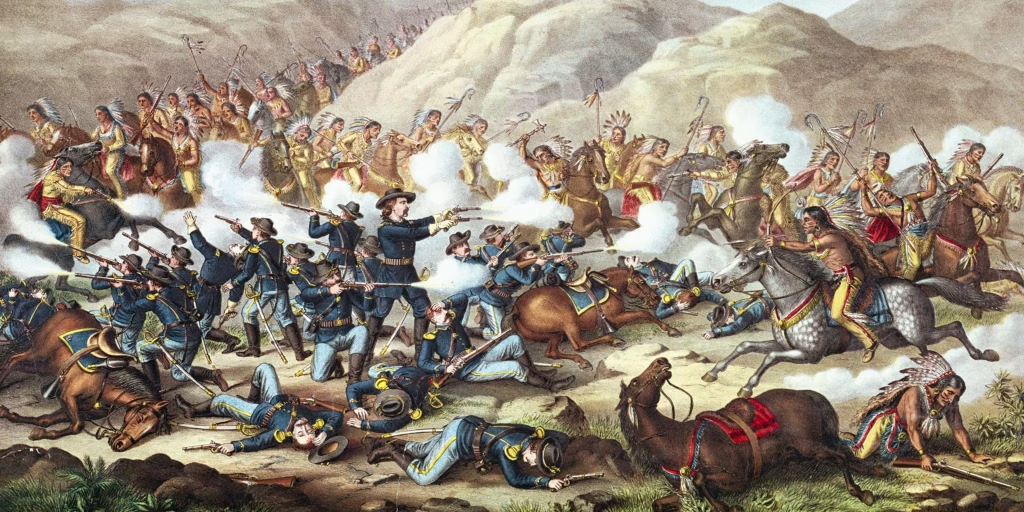
In 1877, most of their land was siezed, and the Sioux were confined to a reservation in Dakota, which included Standing Rock on the western side of the Missouri. As part of the treaties by which they gave up their land, they were promised rations from the Federal government
Sitting Bull (Thathaŋka Iyotake in Lakota) was a Chief and Medicine Man of the Hunkpapa Lakota, and after Little Big Horn fled with his followers to Canada, which they called Grandmother’s Country after Queen Victoria. By 1881, the buffalo were gone and they were starving, so they left Canada to surrender to the US Army in July at Fort Buford, on the current western border of North Dakota.
At last Canada is rid of a most troublesome savage, and the United States has overcome a revengeful foe, and the man whom both Canada and the United States have to thank is Major Crozier of the North-West Mounted Police of Canada.
Ottowa Daily Citizen, September 29 1881

He and his followers were sent down the Missouri on the steamboat General Sherman to Standing Rock Reservation, and then sent farther downstream to Fort Randall.
Sitting Bull has been removed from Standing Rock Agency to Ft. Randall. He was very much opposed to the operation and threatened to break away, organize another force of warriors and murder the whites. The soldiers had to tie his hands and feet in order to get him on the boat, one of the number carrying him on his shoulder as he would a bag of wheat. Care will have to be taken or the old villain will yet make his escape and carry out some of his threats.
Neligh Republican, September 30 1881
He was held at Fort Randall as a prisoner of war for twenty months, before he was allowed to return to Standing Rock.
An Army fort had been established in Standing Rock in 1863, and in 1883 was renamed Fort Yates (after Captain Yates, lately glabrous at Little Big Horn) and manned with ~3000 troops.
In the fall of 1883, the Northern Pacific Railroad was completed, and the new capital of the Dakota Territory was established at Bismarck. The railroad ran from St Paul Minnesota to Portland Oregon, and opened the empty plains and badlands of Dakota for white settlement, where there had only been Indian tribes following the buffalo.


Since there were many German immigrants in the territory, the new capital was named in honor of German Chancellor Otto von Bismarck (1815-1898). The cornerstone of the capitol building was laid on September 5, and dignitaries galore were invited to speak, including Henry Villard, President of the Northern Pacific (born Heinrich Hilgard in Germany), former US President US Grant, and German ambassador Baron von Eisendecker.

As a novelty, Sitting Bull was invited to give the last speech at the ceremony. An Army interpreter had written his anodyne speech, and he gave it in his native Sioux tongue. The intepreter listened in horror as Sitting Bull ignored the lines prepared for him.
I hate you. I hate you. I hate all white people. You are thieves and liars. You have taken away our land and made us outcasts, so I hate you.
Sitting Bull
He would smile occasionally as he continued his diatribe, then sat down when he had finished, enjoying the applause. The translator then got up and gave the English speech that he had written.
The Capitol burned down in 1930.

Three days later, the golden spike was nailed fifty miles east of Helena, completing the Northern Pacific. Sitting Bull was not invited to speak.
Sitting Bull Travels
Major James McLaughlin (1842-1923) was the Indian Agent in charge at Standing Rock. He was married to Marie Buisson (1842-1924), who was the granddaughter of Scottish fur trader Duncan “Bigfoot” Graham and his Sioux wife Hazahotawin. Marie spent her childhood in Indian camps, and was fluent in Sioux. She was considered a leader among Sioux women, and was called Tatiohnakwastwin, or Good Housekeeper Woman.

In March 1884 the Major traveled to St Paul Minnesota to buy oxen. He brought Sitting Bull and his nephew One Bull (Thathaŋka Waŋzila, 1853-1947), for their first visit to a large city.


As he still has great influence with his large tribe, it was thought that it would have a good effect to introduce him further to the white methods and people.
St Paul Glove, March 14 1884

The entourage stayed at the Merchant’s Hotel, owned by Colonel Alvaren Allen (1822-1907).
Globe correspondents are disagreed about the character of Sitting Bull. Some describe him as an aboriginal patriot and others as a savage monster. The Globe is inclined to decide the dispute in favor of S. B., for though his loyalty may be doubted, seeing that he has not manifested it by holding a fat office and calling the outs copperheads and rebels, yet also he has not been guilty of stealing a Presidency, or of associating in the the bribe givers and bribe takers. He is a better man than [US Senator] John Sherman.
St Paul Globe, March 24 1884
It became a running joke for all of his visits to the East, that only bald-headed reporters were safe from his scalping knife.

On St Patrick’s Day he was the guest of honor at the Armory, where the Irish population of St Paul gathered each year.
The immense floor of Armory Hall was filled to its utmost capacity last evening, and in the gallery there was not standing room. Among the immense audience were some of our most distinguished citizens, including Mayor C. O’Brien, Sheriff O’Gorman, and his serene highness, Sitting Bull.
Long before the curtain was raised the hall was filled and few minutes before “the foremost man of all this world,” the great lion of the hour, Mr. Sitting Bull, preceded by Major McLaughlin, entered and proceeded down the middle aisle amid the welcoming acclamations of the assemblage. He and his nephew were provided with chairs immediately in front of the stage.
After the opening musical numbers, Father Shanley gave the oration, praising the Irish of St Paul. As members of an oppressed race, they were glad to welcome another representative of another oppressed race, and extend the hand of welcome to Sitting Bull, who he explained was a descendant of a lost tribe of Irishmen, who were driven by storms and landed in America long ago.
Sitting Bull spoke:
“I came here today to say a few things to you, and I hope my white brothers will hear me. I have come here to speak good words. Today my people are poor and I wish to make it known to my white brother that they are poor. I hope my white brother will help my poor people and teach them to become like white people and have plenty to eat. I hope my children will follow the same path (not war path) of white people. I am glad to see so many white people. I have been happy all day! My heart has been glad. I have seen many people. I have seen my white brother’s home. I have seen his schools and his churches, and it makes my heart glad. I hope my white brother will not forget my poor people in their poverty and in their hunger for knowledge. I hope the white brother will give my people schools that they may learn. I hope they will give them churches to make them good. That’s all I have to say.”
Saint Paul Globe, March 18 1884
The next night, he was at the Grand Opera house to see Roland Reed in Cheek, the new comic play by Fred Marsden, author of the smash hit Bob.


The next night, he was at the Olympic and saw Annie Oakley (1860-1926) for the first time.
Last night [March 19] the party visited the Olympic theater, and the great American squatter was highly edified at the classic character of the performance. He was especially pleased at the performance of Miss [Annie] Oakley, the crack shot, and the handy manner in which this amazon handled a rifle was the occasion of hearty applause from the wily brave.
Saint Paul Globe, March 20 1884
Sitting Bull returned to Standing Rock on March 21, with $100 from signing autographs at a buck a piece. Not everyone was happy with his visit to civilization.
It is enough to fill the breast of every frontiersman with supreme disgust to read of the manner in which Sitting Bull was lionized in St. Paul and Minneapolis. The old villain is a red-handed murderer of the deepest dye, yet he was toadied to as if the laurel wreath of a hero crowned his brow. Even fair ladies crowded up eager to clasp a hand upon which the life blood of women and children is scarcely dry, and smiled upon him as sweetly as they would smile were he an angel from the celestial realms above.
Wadena Pioneer Journal, April 10 1884
Catholic Monsignor Joseph Stephan (1822-1901) had been the Standing Rock Indian Agent before Major McLaughlin, and now served as the head of the Catholic Bureau of Indian Missions in Washington, DC. He thought that taking Sitting Bull on a nationwide tour would do much to improve Indian relations, and proposed it to Secretary of the Interior Henry Teller, who gave him permission if Sitting Bull was willing.
Sitting Bull had become friendly with Colonel Allen while in St Paul, and the Colonel decided to cut Father Stephan out of the money. He traveled to Washington to see Teller, and got permission to lead the tour. He promised Sitting Bull that he would get to meet the Great White Father, accidental President Chester Arthur, and promised him a 25% cut of the proceeds.

New York theatrical manager William W. Kelly was in St Paul with a traveling show, and was hired to manage the tour.
W. W. Kelly has at last struck oil. He is manager for Sitting Bull, the Sioux brute who ought to be killed and exhibited as a mummy.
New Orleans Times-Picayune, September 26 1884


The entourage was called the Sitting Bull Combination, and included Colonel Allen, his son Ehle as Treasurer, Louis Primeau (1854-1903) as interpreter, St Paul newspaper editor Major Thomas Newson (1824-1893), Mrs McLaughlin and son Harry, and Sitting Bull’s entourage.

AN ASIDE – I always look for murder when I write. Ehle Allen was born in 1856, and as the son of Colonel Allen was a prominent and respected member of St Paul society. Ten years after Sitting Bull’s 1884 tour, the city awoke to tragic news in the Globe.

John Clapp was a well-known salesman at a fashionable cigar store, and stopped into the Metropolitan Hotel bar for a few drinks on the evening of June 22 1894. He left to go home at 10:30PM, slightly tipsy. Ten minutes later, a bellboy ran in to exclaim that he had been stabbed and was dying in the hotel office. Doctors were summoned, but he bled to death within minutes.
Clapp had passed two women walking on the sidewalk late at night, and made some trifling remark which Lulu Leyde took affront to. She ran across the street to tell her lover Ehle Allen, who accosted Clapp. An argument ensued, and Ehle pulled a knife and stabbed Clapp in the throat, severing his jugular, carotid and windpipe.
When in liquor [Clapp] is said to have been quarrelsome and a hard man to handle, and also has the reputation of going armed. Allen is not a quarrelsome young man, and his awful act last night seems likely to have been the result of the belief that his antagonist was too much for him or was about to draw a weapon, and was entirely on the impulse of the moment.
St Paul Globe, June 23 1894


Lulu Leyde is a rather dashing-styled blonde young woman that has often been seen on the streets for a year or two. As a young girl she was attractively beautiful, and doubtless her taste for finery and susceptibility to flattery led her into a life that excluded her from the society of good people. She was bright as a young girl, and at the age of fourteen, when she most needed the mantle of good moral influences and restraint, she went out into the rushing waters of a booming city to earn her living. As a book store clerk, she saw the dazzling splendor of people of wealth, who poured out money freely on the great thoroughfare of the metropolis, and passed before her eyes in richness of costume and fine equipages. Her ambition led her beyond a mere clerkship, and she learned telegraphy and stenography.
She married John W. DeVere on February 21, 1893, at the home of her parents. Prior to her marriage she was at the telegraph office in the Merchants Hotel, where she became acquainted with Ehle Allen, who was the clerk in the hotel, and was often seen in his company. A few months after her marriage she went with her husband to the World’s Fair [the Chicago Columbian Exposition]. While there she met a former acquaintance, who recognized her at the theater, and who was on a subsequent evening found in the hotel occupying the same room with Mrs. De Vere. The circumstances were evidently not satisfactorily explained to the husband, as he left his wife to shift for herself before the honeymoon was scarcely over.
She returned to this city, and again went out into the world to do for herself, as many others have done who will not submit to the restraints of what to them seems to be prosaic life. She became an inmate of an ordinary boarding house where she was known to the respectable landlady as Mrs. Moore, the supposed wife of Mr. Moore, who came to see her occasionally, and especially on Sundays. Mrs. Lamb, the proprietress of the boarding house, did not know the pretended husband is Ehle Allen.
St Paul Globe, June 24 1894
Ehle Allen was charged with manslaughter for defending the honor of his pseudo-wife Lulu. On the morning of July 6, in a friend’s empty cottage at Lake Minnetonka, he held a mirror to make sure his aim was true and shot himself in the head, dying instantly.
He concluded that life had nothing more to offer for him, for even in the event of his possible acquittal on the charge of manslaughter, life held no charms for one of his temperament if he was to be forever after a marked man. He had always lived in an atmosphere of sunshine. While he was not egotistical, he nevertheless basked in the rays of popularity. He had always received a large share of personal consideration, and his bright intellect won him hosts of friends. But it was always sunshine until Tragedy spread her wings and the light of his life went out at the moment when, in an excess of rage or jealousy, or, as his friends prefer to think, under the instinct of self-preservation, he unintentionally took the life of one of his fellows.
St Paul Globe, July 7 1894
We now return to Sitting Bull.
The novel combination of St. Paul gentlemen and Indians left last night on the 9 o’clock train, in a special sleeper attached to the regular train, direct to New York, where they open their exhibition at the Grand Eden Musée on the evening of the 15th.
Saint Paul Globe, September 9 1884
They arrived in New York City on September 11, and settled into Grand Central Hotel on Broadway.

The Eden Musée had opened on 23rd St in March 1884. It was a wax museum established by French owners, modelled after Madame Tussauds’s in London and the Musée Grevin in Paris, complete with a Chamber of Horrors. Horrors did not pay the bills, so the Sitting Bull Combination was contracted for a two-week exhibition.

An elderly copper-colored gentleman sat under a broad-brimmed white felt hat in the Eden Musée yesterday, fanning himself with a Japanese fan. He took off his hat, and puffed a pale face cigar. The chief smiled in a most amiable way, and shook hands with all the pale faces he could reach. Then he crossed his moccasined feet and nodded to all the rest. The crowd that paid fifty cents a head to welcome him was so great that it was impossible for a visitor to turn round after he was once caught in the crush.
Spotted Horn Bull, Seen By The Nation [Sitting Bull’s wife], Eagle, Long Dog, Gray Eagle, Crow Eagle, and Flying By sat beside Sitting Bull, wrapped in brilliant blankets and bears’ tails, and smoked long Indian pipes in peaceful meditation.
Mrs. Sitting Bull and Mrs. Spotted Horn Bull sat down cross-legged on the red blankets in front of a big canvas tent, and let the thousand or more spectators admire the bold and fantastic way their faces were painted. Wahunkeza Luta (Princess Red Spear) reclined modestly in a corner by a stuffed prairie dog. She had red paint and brilliant beads and most gorgeous moccasins. She is the handsomest Indian maiden who ever came East, and posed smilingly as the professional beauty of the Sioux tribe.
New York Herald, September 16 1884
A few blocks from the Musée lived Elizabeth Custer (1842-1933), widow of Sitting Bull’s most renowned victim. She had been impoverished by his death, and rented rooms on 18th St. Four days before Sitting Bull arrived, her apartment caught fire and many of her mementos were lost. She finally prospered after 1885, when she wrote the first of her three books about her beloved George.
They visited Thomas Edison’s factory on Goerck St.
The Sioux show a lively appreciation of the immense buildings and other wonders of New York. They came through Chicago in the night, so that St. Paul was the only large city they had ever hitherto seen. Edison took them over to his factory the other day, and put electricity through its paces for their benefit. The old theory that savages are never astonished at anything will have to be modified. It comes nearer the truth to say that nothing astonishes them as long as they suppose it to be supernatural: only when they are told that men produce the results without aid from any spirit do they begin to show surprise. Lightning never surprises an Indian as long as he supposes that it is only the flashing flight of the thunder-bird angry with somebody, and swooping down for a victim; but when told that it is only a force that man can capture and tame and bottle up and turn on his wires, then he shows astonishment.
Montclair Times, November 1 1884

SITTING BULL AT CONEY ISLAND There was considerable travel to Coney Island yesterday owing to the mild temperature, but there was very little going on there. The Oriental, Manhattan Beach, and Brighton Beach Hotels were closed, and everything was desolate and quiet in that vicinity. Sitting Bull and his combination visited the Island in the afternoon, and attracted a great deal of attention. The noble reds were taken up into the observatory, where they expressed great surprise at the vastness of the sea.
New York Times, September 29 1884
Three months earlier the first ever roller coaster had began running at Coney Island. The Switchback Railroad ran at the astonishing speed of 6 miles per hour; there is no mention of whether Sitting Bull rode it.
On October 5, they departed for Philadelphia, and lodged at the Continental Hotel.

As they were leaving the train station, a lounger noticed the beautiful Princess Red Spear and remarked “Charley, twig her nibs. You’d better not try to mash her. Her natural protector looks wicked.”
Mr. Hughes, the day clerk, who has a particularly fine head of hair, wore his hat during all the time that his copper-colored guests were on the same floor with him. He said that it was wicked to throw temptation in the way of the poor red man.
Philadelphia Times, October 6 1884
Mashers were lowly, ungentlemanly, obnoxious fellows who suggestively accosted women on the street; mashing a Red Indian princess would be a once-in-a-lifetime achievement.

As soon as they settled into their rooms, the first reporter arrived.
The famous Sioux chief sat in a room in the Continental Hotel yesterday afternoon, surrounded by half-a-dozen of his chief followers, smoking the pipe of peace preparatory to an attack on the white man’s food that was being made ready in one of the private dining rooms.
Sitting Bull was seated in a large upholstered arm chair. He had on a long hunting shirt falling below his waist, blue trousers and beaded moccasins. His wife stood behind his chair arranging his hair into two long braids, which were afterward thrown forward over his shoulders. He did not seem at all warlike, but appeared readily to adapt himself to his surroundings. The pipe, which had a long, thick stem and a narrow earthen bowl, was passed from one to the other, each taking a few whiffs.
Sitting Bull was asked whether he would like to live in the East. The chief thought a moment and then said, “Yes, if I was a young man and had no children to look after I should like to live here very much.”
The managers say that the trip has impressed the Indians with the power of the white man. They saw in New York alone more people than they thought were in the whole country, and Sitting Bull has expressed to the interpreters the hopelessness of any conflict by the Indians.
They will give an exhibition at Association Hall [home of the YMCA] on every afternoon and evening this week, Sitting Bull will deliver an address on the wrongs of the Red race, and there will be songs and dances.
Philadelphia inquirer, October 6 1884
The next morning they drove around the city in carriages. Street Arabs followed the carriages, yelling “Oh you savage!” and “Do you want a glass of blood?” What, you ask, is a Street Arab? This was the late Victorian term for a homeless, vagabond boy, who made his living however he could, without regard for legality. The most famous Street Arabs of literature were the Baker Street Irregulars, who provided invaluable services to Sherlock Holmes, who never investigated a scalping.
Afterwards, they made their first performance at Association Hall, and repeated it for the evening audience.
In the evening the warrior, his wife, the Princess Red Spear and another lady and six chiefs held a reception at Association Hall. Their nation and themselves, their past and present, together with their future aspirations, were eloquently discoursed on by Major Newson, who introduced the noble redskin warrior and made him sing, talk and dance for the amusement and instruction of the audience. Mr. Bull made a feeling speech, which was interpreted by Louis Primeau.
Philadelphia Times, October 7 1884
On October 12, they attended mass at St John the Evangelist Catholic Church (completed in 1832), and attracted a large number of admirers.
They are members, actually or nominally, of the Roman Catholic Church, and the party seemed quite familiar with the service, their chief being edifyingly attentive. Their costumes were greatly admired, some of the ladies expressing a sentiment bordering almost upon covetousness in reference to the gorgeous wrappings in which the strangers had robed their stately figures.
Philadelphia Inquirer, October 13 1884

For two weeks, they performed twice a day at Association Hall.

They left Philadelphia, and on October 20 began their next engagement in Brooklyn, appearing twice a day at the Music Hall, in what was billed as a truly moral show.

New York Senator Roscoe Conkling was branded as frivolous next to Sitting Bull:
THE STOLIDITY of the North American Indian is truly awful. One finds it difficult to believe that the crafty chief who made such a famous fight in the Rocky Mountains a few years ago is now on exhibition at fifty cents a ticket. Buffalo Bill’s Indians and the ordinary run of red men who appear in border dramas at the cheaper theaters have always impressed me more or less; but none of them approach the solemnity of Sitting Bull. Compared to his dignified mien Roscoe Conkling’s manner is frivolous, frolicksome and gay. He sits in somber silence, and looks at the unfortunate white man who is attempting to be agreeable with a cold and reserved glance. You may enter the presence of Sitting Bull with a brass band, throw hand springs before him, smile, weep, or have convulsions, aud he will sit there and look at you with a cool, intelligent but utterly uninterested eye. Nothing disturbs him; he never smiles. and before he delivers a remark he thinks it over carefully, turns it into a dozen different shapes, then expresses it with the weight of a philosopher, and sinks into silence for another twenty-four hours. The remark is in many instauces worth repeating. As witness the only utterance of his which has been recorded since he came to New York. He observed that he saw boys working for money in New York, when they should be at play. There are certainly enough round shouldered, puny and overworked boys in New York to excite the compassion of even a less emotional man than Sitting Bull, if such a man exists.
Brooklyn Eagle, September 14 1884
Throughout the tour, Major Newson opened each performance with a lecture decrying the treatment of the Indians on their shrinking reservations.
He claimed the tour of the party was to raise money to help the tribe. He claimed the system of caring for the Indian was a mistake. They were placed on reservations, under care of farmers who were too few to teach them anything about agriculture, and with one hand on their rations and the other hand on the soil, were told to be good Indians and rise. He hoped the people would demand that Congress should give the Indian a right to own some land. He could not call a foot of the land he occupied his own, and yet it was deeded him from the Great Spirit. Any native of other lands, by becoming a citizen, could secure a fee of 160 acres, but an Indian could not. Indian agents had risen from poverty to the possession of $300,000 in a few years, not by robbing the government, but the Indian. Good flour became hard in transit, pork grew musty and rusty, coffee changed to pole beans, and other mysterious changes daily went on. There would be no need to send them rations if they were taught how to support themselves.
Brooklyn Union, October 21 1884
The tour was planned to last two years, with half in Europe, but was suddenly cut short when Father Stephan complained and brought politics to the front.
Ehle [Allen] says Father Stephan is apparently at the bottom of the tribe’s return, as he expected to exhibit them himself, and, not obtaining this boon, secured from Secretary Teller an order calling them home, claiming, if they were not returned, Wisconsin would go Democratic. What reasons he assigns for this assertion are not known.
Sioux City Journal, October 31 1884
Interior Secretary Terry ordered them back to the reservation, after the last Brooklyn show on October 25. Sitting Bull did not meet Chester Arthur, and the Combination arrived back at Standing Rock on October 29.
Seven months later, on June 9 1885, Sitting Bull and other Sioux notables left Standing Rock again to meet the Great White Father (now embodied even larger as Grover Cleveland), and then join Buffalo Bill Cody’s Wild West Show, representing one of the Savage, Barbarous and Civilized races.
BISMARCK. The following famous Sioux Indians left for the East last evening to join the “Wild West” show: Sitting Bull, Crow Eagle, Fool Thunder, Frisking Elk, Iron Thunder, Crows’ Ghost and Slow White Bull, all warriors of distinction; Great Black Moose, a daughter of Mrs. Crow Short; Mrs. Slow White Bull and daughters, and others.
Critic and Record, June 10 1885
Sitting Bull first met the new Secretary of the Interior, Lucius Quintus Cincinnatus Lamar II, followed by a visit to the office of Philip Sheridan (1831-1888), Commanding General of the United States Army.
After leaving the Interior Department, Sitting Bull and Buffalo Bill called at the War Department and paid their respects to Gen. Sheridan. The Indians wore their war costume. Their faces were embellished with red and yellow paint, and on their heads they wore immense single feathers. Sitting Bull’s head was adorned by a number of feathers of large size. In Gen. Sheridan’s room but little conversation was indulged in. The Indians left the room in single file and passed about a hundred War Department clerks who stood in the corridors. Before leaving the State, War, and Navy Department building the party visited the State Department library and examined the original copy of the Declaration of Independence and other relics.
National Republican, June 24 1885
Sitting Bull made his long-awaited visit to the White House on June 23.
When he called at the White House yesterday, Sitting Bull expected to have a pow-wow with President [Cleveland], and was disappointed that the interview was short. The interpreter told him that the Great Father was very busy and that hundreds of white men come here and stay months and cannot see him.
Critic and Record, June 24 1885
His response was “White man one great damned fool.”
Not everyone approved of the President seeing him:
SITTING BULL had the impudence to call on the President and received a snub that penetrated even his thick hide. The President should not have stopped with snubbing him; he should have ordered him back to his reservation, with the information that the only way he can secure any favor from Washington is by good, steady work in the cornfield and the potato patch.
National Tribune, July 16 1885

The Wild West Show performed in Washington, Philadelphia, New York and Boston, and then went to Canada. After seeing her in St Paul the previous year, Sitting Bull now performed alongside Annie Oakley, who he called Little Sure Shot (his great-grandson later said that the correct translation was Little One Who Does Great Things).


The previous year, Mark Twain saw the Wild West Show twice in New York, and wrote to express his admiration:
DEAR MR. CODY–I have now seen your Wild West show two days in succession, and have enjoyed it thoroughly. It brought vividly back the breezy wild life of the great plains and the Rocky Mountains, and stirred me like a war song. Down to its smallest details the show is genuine–cowboys, vaqueros, Indians, stage-coach, costumes and all; it is wholly free from sham and insincerity, and the effects produced upon me by its spectacles were identical with those wrought upon me a long time ago by the same spectacles on the frontier. Your pony expressman was as tremendous an interest to me yesterday as he was twenty-three years ago when he used to come whizzing by from over the desert with his war news; and your bucking horses were even painfully real to me, as I rode one of those outrages once for nearly a quarter of a minute. It is often said on the other side of the water that none of the exhibitions which we send to England are purely and distinctively American. If you will take the Wild West show over there you can remove that reproach.
Yours truly, MARK TWAIN.
Two visitors to the show in Canada gave their impressions:
The exhibition includes glass ball shooting with rifle, shot gun and revolver, on foot and riding at full speed, and clay pigeon shooting, several giving exhibitions of their skill with the gun, including Buffalo Bill.
The attack on the mailcoach on the Deadwood line in the Black Hills country by Indians and the relief by cowboys was a most interesting and exciting feature The management have the genuine coach, a heavy lumbering affair that has often been baptised by fire and blood, and this is drawn by a team of six mules. A number of passengers were taken on and the coach moves off with a parting injunction and “Good luck to Ye.” Halfway around the track the Indians give chase, the mule team, under the whip, cannot get away from them, the passengers and those in charge begin firing, and up the track the fiendish redskins in their warpaint come surrounding the coach and keeping up an incessant fusilade. It seems all day with coachman and passengers, when like a whirlwind down come the cowboys, Buffalo Bill at their head. The Indians are dispersed and driven back upon the in-your-mind prairie. This scene is very realistic, and is sufficiently exciting for almost anybody.
One of the features of the show is the venerable chief Sitting Bull. The meeting between him and Buffalo Bill, and the struggle in which the latter came off victorious, was heartily enjoyed.
The Brantford Expositor, September 4 1885
I went there, in company with several thousand others, and saw the “noble red man” as he is, squaw, papoose and all, with the only and original “Sitting Bull” in their midst, and with whom of course we all had to shake hands. In their swarthy faces and wild costumes, their erect figures and loose open gait, their dashing horseback feats, and crude wigwam customs, we beheld the veritable “Injun” of whom we heard, about whom we dreamed, and whom in our childhood days we feared might suddenly rush in upon us and take away our scalps. And yet all this was tame indeed, compared with their attack upon the Deadwood stage coach drawn by its six-mule team, or their raid upon the lonely settler’s log cabin, in both of which they were repulsed by Buffalo Bill and his band, including a number of cowboys late from their ranches in the far west. The fierce battles between Indians and cowboys, in which a hundred horses mingled, and revolvers rattled, [filled] the field with smoke. All this and a hundred other scenes seemed to bring the Western prairies and their wild rangers, both man and beast, directly before us.
Welland Tribune, September 11 1885
The tour ended, and Sitting Bull returned to Standing Rock.
BISMARCK, Oct. 15 (Special).—Sitting Bull and his band of Sioux warriors arrived here this afternoon on their return from the East, where they have filled an engagement of fourteen weeks with Buffalo Bill’s ” Wild West ” show. The old chief has been living pretty high. He never weighed so much before and never smiled with so much complacent aestheticism.
New York Tribune, October 16 1885

In 1887 Congress passed the Dawes Act, which decreed that each Indian family would be allotted a small amount of land to farm, instead of roaming on the reservations. Senator Dawes declared that for the Indians to be civilized, they must “wear civilized clothes, cultivate the ground, live in houses, ride in Studebaker wagons, send children to school, drink whiskey and own property.” The actual intent was to expropriate more of the reservation lands for white settlers.

I never knew a White man to get his foot on an Indian’s land who ever took it off.
Senator Henry Dawes
Sitting Bull returned to Washington in 1888 as a member of the Sioux Commission, to consider a new treaty implementing the Dawes Act on the Sioux lands. They lodged at the Belvedere, and first met Secretary of the Interior William Vilas on October 13.

The delegation from the Sioux tribes, consisting of seventy-two chiefs, will arrive in this city tomorrow night. They will be quartered at the Belvedere House. It is arranged that they will have interviews with the President and the Secretary of the Interior on Saturday. The object of their visit to the city at this time is to have a talk with the President relative to the treaty which the Commission is now negotiating with them.
This will be the largest delegation of Indians that ever visited this city and the most important since the war. They represent a population of over 25,000 Indians, composing the different tribes of the Sioux. The Sioux are the largest tribe in the United States, and are regarded as the most powerful. Nearly all the members of the delegation will appear in civilized dress.
The object of the law which the Indians are asked to consent to is the relinquishment of their right of occupancy to about 11,000,000 acres of the great Sioux reservation in Southern Dakota, and the division of the remainder into six separate reservations for their occupancy.
Evening Star, October 11 1888
Sitting Bull enjoyed looking into the shop window displays as he strolled around Washington, including the studio photographer’s displays.
The other day he came plump on a picture of Gen. Custer. It was one of those equestrian pictures in which the famous cavalryman’s hair floats off in picturesque blonde profusion. Sitting Bull stood for a long time before it. He seemed to recognize his victim, and as he walked away, glanced back over his shoulder. How Custer’s sense of the ludicrous would have been aroused could he have surveyed his slayer as he stood there arrayed in misfit store clothes and wearing on his bushy head a tall, white plug hat.
Critic and Record, October 24 1888
One delegation wear wide-brimmed white sombreros, cowboy hats they are called. Another portion of the visitors cover their long black locks with a black slouch hat, which looks very much civilized. But the crowning achievement in this line is the tile worn by a number of the Indians; it is an ordinary white beaver decorated with a black band. These hats were given the Sioux by some of their democratic friends in the wild West, who had been holding a political meeting.
Evening Star, October 15 1888

Blakely Hall (1861-1944) was a prominent journalist of the day, and wrote about encountering Sitting Bull:
The mixture of races is very striking in Washington at all times. I was at the Belvedere House the other day talking with Sitting Bull, one of the chiefs of the Sioux nation, and as the day was warm we wandered out and started down Pennsylvania avenue together. The chief wore an ordinary business suit, moccasins, and a derby hat. I had forgotten for the moment that he was an Indian, and stopped upon the threshold of the door fearing that the sight of a red man would attract a crowd, but we walked for two blocks and not a man turned his head. It is impossible for me to conceive of any sort of savage who would attract attention in Washington. On this occasion Sitting Bull pointed to a group on the corner of Four-and-a-half Street and the avenue. A drunken colored man had found one of the Indians wandering along alone, and in a splurge of hospitality had linked arms with him and taken him up to a fruit stand. There he was solemnly feeding the red man grapes, while the untutored child of the forest swallowed them with grunts of satisfaction. An old Irishman jabbered at them continually from the other side of the fruit cart. The negro stopped for a moment from his satisfied contemplation of the Indian’s features, and looking into a neighboring laundry saw the grinning mug of a Chinaman peering over the curtain. He entered abruptly and with a profound salaam dragged the Chinaman out and handed him a bunch of grapes. There they stood, Indian, Chinaman, black man, and Irishman pleasantly munching the fruit, and not a soul in Washington city looked twice at the group. The only native American among them was the Indian. He said never a word, but the way the grapes disappeared was an indication of American enterprise and push from way back. [Sitting Bull] had little idea of where the Chinaman or the negro had come from. I tried to explain about Ireland, Africa and China, but the red man cannot conceive anything bigger than the United States.
Patriot News, November 17 1888
The Sioux first met Secretary Vilas in his office on Sunday October 14.

The Standing Rock delegation, including Sitting Bull, John Grasse (1836-1918), Chief Gall (1840-1894), Mad Bear (1836-1915) and other chiefs were given seats in front. John Grasse is the counselor of the tribe, the attorney-general as it were. Chief Gall is the General Grant of the Sioux Nation. It was he who led the forces of the Indians in the Custer massacre. Sitting Bull is fat and has rather a besotted look. He is called by some of the tribe “Old Miss Lazy-Bear.”
The Critic and Record, October 15 1888

John Grasse spoke:
These 11,000,000 of acres of our land which you propose to open to your people, the majority of your people do not wish. Furthermore, the price proposed–50 cents an acre–is not enough. The land is worth $1.25 per acre, the price which the Government sells its land for. Our fathers were blind; they knew not the worth of their lands. You cheated them. We are now poor when we should not be, and because you robbed us. You promised us twenty years ago to give us twenty years of schooling. The time has expired, but we have only had ten years’ of schooling for our children.
The Critic and Record, October 15 1888
Mad Bear spoke:
We are redskins, but we were created by the same God and intended to live. You should pity us and help us. In regard to the treaty of ’68 we were told that whatever was given us should last for thirty years. You have failed in the promise to give us twenty years of schooling. Fulfill the previous treaties before you propose others. The reason we are backward about signing this treaty is this: When we had plenty of land we sold without thought; now we are reduced to our last and must think well before parting with it.
The Critic and Record, October 15 1888
At noon they returned [to the Belvedere] and took lunch. After lunch they sat around in the lobby and smoked, attracting considerable attention. Sitting Bull, being better known than the others in the party, commanded most attention. All of the chiefs are converts to the practice of smoking the seductive but deadly cigarette. Nearly all of the chiefs provided themselves with packages of the “My Sweetheart” brand and spent an hour or two in smoking.
Washington Post, October 14 1888
The Sioux Commission posed on the steps of the US Capitol on October 15, with Sitting Bull at far left.

On October 17, the Sioux returned to Vilas’ office to hear his response, all of them wearing Grover Cleveland campaign buttons. After they were seated, 20-30 women spectators were seated behind them to enjoy the proceedings, and Vilas spoke:

I see you are men of understanding, and you know how the white people have increased in numbers and pressed around your reservation on every side. Rallroads have been bulit up to it, north of it and south of it, and they are building railroads west of it. The country is being taken up by settlers and cultivated in every direction. The buffalo is gone and all other game is pretty much gone, too. You don’t get much now from this reservation to help you to live. What you get from the reservation now is chiefly in the way of farming or raising cattle. You have seen that the white people are able to get a great deal more from the land than you have been doing. On the same number of acres that you occupy there would be hundreds of thousands of white people if they had time first to improve and cultivate the land. You see right here in this city ten times as many people as there are Indians on your whole reservation. It is education and knowledge which enable white people to get so much more out of the land than you have been doing yourselves. You have seen in this city these big buildings here; you have seen the railroads on which you traveled; you have seen the houses in which white people live, and you now know that it is education which enables them to do what you have not done. If you men had been educated from boyhood like the whites, you, too, would have big houses and live much more comfortably. It is plain to every thinking man that you must change your mode of life, because everything to which you have been accustomed has changed.
Evening Star, October 17 1888
Vilas made the final offer of the United States: the Sioux would receive $1 per acre for land sold within three years, then 75 cents for land sold in the next two years, then 50 cents for land sold after five years.
As the party was dispersing, several of the chiefs approached Secretary Vilas and urged the importance of their going back to their people to discuss the present phase of the matter, but he replied emphatically: No, no; we must make some progress towards a settlement. You must either signify your assent or we will end the whole negotiation. We will have no boy’s play.
Evening Star, October 17 1888
On October 19 the Sioux held their final meeting at the Belvedere, and submitted written responses to Vilas. A small minority of fourteen accepted the offer; the majority rejected it, insisting upon $1.25 per acre.

The fourteen made a final visit to Vilas on October 20.

Secretary Vilas expressed a wish to see the members of the Sioux Indian delegation who stood out in favor of the Government propositions, and so at 2 o’clock to-day 14 Indians called on [him].
The Secretary commended the course pursued by the Indians, and then bade them good bye. The entire delegation were presented to the President [Cleveland] at the White House at 2:30 this afternoon. There was no speech making, the President merely shaking hands with the Indians.
Washington Evening Star, October 20 1888
The Sioux left Washington on October 21 to return to the reservation, while the final decision on the division of their land was taken to Congress. The next Great White Father, Benjamin Harrison (grandson of Old Tippecanoe, brief 9th President William Henry Harrison), was elected on November 6 1888, defeating Cleveland in the Electoral vote while losing the popular vote.
Railroads, cattlemen and squaw men opposed opening the reservation to settlers. The railroads had always been given huge tracts of land in return for laying track; typically they were given miles on either side of new track to sell at huge profits. The cattlemen wanted free range land, instead of fenced farmland. Squaw men were whites married to Indian women, who would not be allowed to receive the farm allotments which would be given to the Indians.
The Sioux Indians are completely under the control of a few arrogant and self conceited chiefs, and these chiefs are largely under the control of the Northern Pacific and Northwestern railroad companies and a few avaricious white or squaw men who, with a few chiefs, are reaping a large fortune from the common property of their own people. The Northern Pacific railroad, as we are advised, own a large amount of real estate in Dakota that they desire to sell at profitable figures, and if this bill should become a law and thereby open up 11,000,000 acres to settlers at a nominal figure, compared with the prices they ask for theirs, the market for their lands will be closed for many years to come. So they, with their mighty power, oppose the bill.
Bismarck Tribune, January 11 1889
It is evident that with the advancement of civilization among the Indians, the “squaw men” must become a thing of the past. During the summer and fall just ended many complaints have come to the Secretary of the Interior to the effect that the work of allotting lands to the Indians had been greatly hindered by the opposition of the Indians led by “squaw men” or white men who had married Indian women and acquired property and influence in the tribes in which they had resided.
Augustine Herald, January 4 1888
Congress finally passed the bill in February 1889, taking 11,000,000 acres from the reservation and dividing the remainder into six small reservations. The bill did raise the payment to $1.25 an acre for the first three years, meeting the Sioux demand, and also required 3/4 of all adult male Sioux to vote in favor of the bill.
WASHINGTON, Feb. 28.—The conference report on the Sioux reservation bill was agreed to by both houses today, and the bill will go to the president tomorrow for his signature. The bill opens to settlement 11,000,000 acres of land, and provides money to pay the Indians therefore, so that there will be no trouble in securing their relinquishment.
Daily Plainsman, March 1 1889

The Secretary of the Interior shall cause a census of the Sioux tribe of Indians to be carefully taken by a special agent to be appointed for such purpose, with a view of ascertaining how many of them are able to support themselves. And after such census has been taken, only those Indians that are found to be unable to support themselves by reasonable exercise shall receive rations from the government.
Pioneer Express, March 1 1889

Susanna Karolina Faesch was born in Basel Switzerland in 1844 and emigrated with her mother to Brooklyn in 1852. Susanna married a doctor, left him for a married man, had a son with her lover, and was then abandoned. She returned to her mother’s house with her son, and inherited money on her death in 1887. She became passionate about Indian rights, and joined the National Indian Defense Association, which had been founded in 1885.
Susanna changed her name to Caroline Weldon, and in the summer of 1889 moved with her son Christie to live at Sitting Bull’s camp on the Grand River in Standing Rock. She befriended Sitting Bull, and served as his interpreter, secretary and advocate. She was also an artist, and painted four portraits of Sitting Bull. The Sioux named her Woman Walking Ahead.

On November 2 1889, the Dakota Territory was divided into Dakota and Montana, and Dakota was admitted to the Union as two states, North and South, so that the Republican party would get four (Casey, Pierce, Pettigrew and Moody) new Senators, instead of two.
After a year of cajoling, finagling and bribery, the 3/4 vote of the Sioux was declared a success.
It was a difficult task to obtain those signatures. Red Cloud at Pine Ridge, and Sitting Bull at Standing Rock, have been the reactionary leaders who sought to prevent the commission from succeeding. It was a contest between the coffee coolers who hang around the agency, draw rations and mourn for the past, and the progressive element who keep away from the agency and work. It was a contest between the blanket Indians and those who desire civilization The latter won and showed Red Cloud and Sitting Bull how little influence they really had.
Washington Post, December 29 1889
In December 1889, the Sioux chiefs again traveled to Washington to ratify the final details of the treaty; this time, Sitting Bull was not invited.


Sitting Bull is very much incensed because he was not taken to Washington with the delegation of the Sioux chiefs who recently had a consultation with President Harrison regarding their lands. Sitting Bull now fully realizes that he is unpopular with Agent McLaughlin and all in authority, and he is vehement in his denunciation of the agent and the more popular chiefs. It is a particular bitter pill for him to have John Grass and Gall, his two bitterest enemies, recognized as leaders while he is ignored. He says that Grass and Gall have been traitors to the Indians, and they sold out their people in the conference which resulted in the ceding of their land, which will soon be open to settlement. In an interview he said:
“I have always been a friend to my people. I have not been like Grass and Gall, who sold them out. I am no good with white men, but the time will come when the Indians will realize that I am right.”
Evening Star December 30 1889

The President gave a reception yesterday afternoon [in the East room] to the delegation of Sioux Indians now on a visit to this city. The President spoke to the delegation through an interpreter:
“I am glad to meet so many representatives of the Sioux nation. A few years ago, while a member of a Senate committee, I visited your reservation and saw your homes and farms. I want to assure you I have a sincere interest in the welfare of your people. Your true interest is in the direction of legislation to settle each of you on a farm of your own. It is the policy of the Government to give to your children the advantages of schools, which you have not had. I will read with pleasure the report of the commission, and it will give me still greater pleasure to aid them in securing from Congress those laws that are necessary to meet the suggestions made by the Commissioners.”
Washington Post, December 20 1889
On February 10 1890, President Harrison proclaimed approval of the treaty and opened the land to settlers. Boomers had been sitting on the east bank of the Missouri for months, waiting on the telegraphic signal; just as ten months earlier the Sooners had waited in Arkansas before racing into Indian Territory (Oklahoma).

CHAMBERLAIN, S. D. — The report of cannon this afternoon startled the crowd camped here awaiting an opportunity to get upon the Sioux reservation lands, which turned out to be the signal for a crowd of town-site boomers who were secreted in the heavy timbers in American Island to get upon the covered bottom in the west side of the river. Teams with loads of lumber were started on a dead run across the river, but it was evident that the local boomers had secured an advantage by reason of their closer proximity to the lands.
The city is in a great uproar to-night. Bells ringing, whistles blowing, cannons booming, shouting of excited men and the rushing of team make a veritable bedlam of the city. The Iumber yards will be rushed to their utmost capacity all night. The boomers are too anxious to await the arrival of dawn, and by morning the appearance of the reservation for many miles in every direction will have undergone a great transformation. Settlers who have lumber on the ground are erecting houses by the light of lanterns.
The local town-siters, who got the advantage of the other boomers for the possession of the site, have arranged for representation in nearly fifty branches of business. Inside of forty-eight hours the buildings will have been erected and everything in running order, with a population of between two and three thousand.
It is fortunate that the proclamation came at this time, as a few weeks later crossing would be dangerous. With the river filled with floating ice, accidents would certainly have happened.
Washington Post, Februaary 11 1890
Exit Sitting Bull

On New Year’s Day 1889, there was a total solar eclipse across the western United States. During the eclipse, a Nevada Paiute named Wovoka (1856-1932), called Jack Wilson by the whites, fell into a trance and had a revelatory dream about God and Jesus Christ. Jesus the Messiah had returned, and would resurrect all of the dead Indians, restore the buffalo, and remove the white interlopers. He spread his dream via letters and emissaries, beginning the Ghost Dance movement.
Do not tell the white people about this. Jesus is now upon the earth. He appears like a cloud. The dead are all alive again. I do not know when they will be here; maybe this fall or in the spring. When the time comes there will be no more sickness and everyone will be young again. Do not refuse to work for the whites and do not make trouble with them until you leave them. When the earth shakes [at the coming of the new world] do not be afraid. It will not hurt you. I want you to dance every six weeks. Make a feast at the dance and have food that everybody may eat. Then bathe in the water. That is all. You will receive good words again from me some time.
Wovoka
By 1890, the Ghost Dance had spread to tribes all across the west. Sitting Bull’s nephew Kicking Bear (Matowanatitaka) traveled to Nevada to meet Wovoka, and brought the dance back to the Sioux.


The religious craze among the Indians, known as the “Coming of the Messiah,” has at last reached [Standing Rock], and is making more or less headway among the different bands, and has taken a determined hold upon Sitting Bull’s band, of the Uncpapa tribe, with Sitting Bull himself as the “Apostle of Messiah” to the Indians of this agency. There have been numerous dances in connection with the craze, or belief, the last of which took place at Sitting Bull’s camp on the Grand River, forty-five miles southwest of here, last Sunday, to which Agent McLaughlin had dispatched an Indian policeman, One Bull, nephew of the apostle [who accompanied Sitting Bull to St Paul in 1888], with orders to prevent any more dances, and to disperse any gathering of Indians in this cause.
It seems that a few weeks ago, an Indian named Kicking Bear, a worthless, overbearing, good-for-nothing fellow has recently been visiting the Shoshones, and returned to Cheyenne Agency, claiming that he was an inspired apostle of the Messiah. Some of the young men of Sitting Bull’s band went down to Cheyenne Agency and attended the dances and brought Kicking Bear up to Bull’s camp, and he commenced his discourses, having old Bull himself a chief follower, and the old reprobate started into the Messiah business himself.
Kicking Bear tells the following story of his visit to the end of the world:
He travelled a number of days and nights on the white men’s steam wagons, until they stopped, and could carry him no farther. He then secured a pony and went on one day’s journey beyond the railroad terminus, over an uninhabited country. At evening he came across a man who had long hair and had his hands and feet pierced with nail holes. This was the Son of God. By a peculiar twisting and mysterious motion of his hands he was making money and light wagons, and they were rolling from him by the score. Kicking Bear asked him who he was. He said he was the Son of God, and if he would wait awhile, till he had made a few more dollars and light wagons, for his red children, he would take him up and show him his father.
Kicking Bear waited. When the wagons and dollars were completed, the Son of God turned around and showed Kicking Bear a ladder leading up through the clouds and commanded him to follow hım up. He went with him, and upon reaching the top of the ladder and passing through a small hole in the clouds, he found himself in a beautiful country, and at a short distance from the opening in the clouds, seated on a chair, was the Great God, Father of the Son.
Kicking Bear was about to speak, and tell him who he was, when the Great God said: “Never mind, Kicking Bear, I know who you are, and know all about the suffering of my red children at the hands of the white men, and I am now going to make a change in the affairs of the world. I will establish a new religion for the red men, and they must have regular dances to keep it in mind. I am going to rebuild the world, will cover the ground over with thirty feet of new soil, and it will sweep over the world like a wave of the ocean, covering up all the white people; but the red children by their dancing will be able to stamp the new soil under their feet and so climb to the top. When the new soil is all over the earth, the Son of God will again make dollars, light wagons and buffaloes for my red children, and if there are any white men left they will not have any more power over the red men; their power will be wasted and they will not be able to make powder strong enough to send a bullet through my red children’s skin. There shall not be any more trader’s stores, and my red children shall all live happily as they were 400 years ago.”
Having seen the end of the world, [Kicking Bear] turned his horse about and made quick time to the end of the track, where he again took the train for Cheyenne agency.
Maj. McLaughlin has been in the field visiting the Indians in their camps, warning them against this man Kicking Bear and Sitting Bull also, and trying to convince them that such things cannot possibly take place. Mrs. McLaughlin, the agent’s wife, is today and has for weeks been visiting the Indians in camp, persuading them against these men and their followers, as has also Louis Primeau, the agent’s trusted interpreter.
Black Hills Weekly Times, November 8 1890

A dispatch from [South Dakota] reports an interview with Debose, a Yankton Reservation Indian, who was leading a party with fifteen or twenty wagons loaded with his people. These Indians are well taught, and it had been thought that they would not be led away by the Messiah craze that is now causing so much excitement among the Indians west of the river, but the talk with Debose brought out the fact that they also believe in the coming of the Indian Messiah, who will wipe the whites from the face of the earth. Emissaries of the Messiah are now working among the Sioux, notwithstanding the vigilance of the agency authorities.
New York Tribune, November 21 1890
An Indian spy named Ghost Horse participated in the ghost dances and learned that the intention of the hostiles was to [go into winter quarters at Pass Creek] and to subsist on the cattle being wintered in the Bad Lands. He said there was a number of educated Indians … who came to Pierre regularly every few days and bought copies of each daily paper, which they took back and read to the council composed of chiefs and leading braves, interpreting into the Sioux tongue all accounts of the Indian uprising. The Indians all seemed to enjoy this, laughing heartily when they heard of the great alarm everywhere. It seemed to strengthen their belief that the Messiah was coming, and that the whites were becoming afraid and ready to die off or flee and leave the land to the Indians.
The Inter-Ocean, Novembe 30 1890

In November 1890, the Mother of Christ went on trial at Standing Rock before an Indian tribunal led by John Grass (a member of the 1888 Sioux Commision), with Major McLaughlin in attendance. When called to the rail, she gave her name as Walutawin, wife of Iiksoga.
The Indians have evidently in many instances gone stark mad. The most exciting among the many trials which have occurred here the last fortnight was that of the alleged Virgin Mary.
[She testified] I am the mother of Christ, who is now upon this earth making preparations for rebuilding it. The earth is to belong solely to his chosen people, and this continent is to be extended much farther west, taking in a part of the great sunset water. The eastern part of the continent will be abandoned, but in the western part great herds of buffalo will wander as in the days of long ago, and simultaneously with the disappearance of the whites from the earth will come the resurrection of all the Indians who now sleep, and forever more they will wander over the earth with no one to question their rights to kill the buffalo, no one to say “Do this or I will put you in the guard-house.” In those days there will be no reservation, no messenger from the Great Father to say to the Indians “Come back here, stay on your reservation.”
She refused to tell anything about the orgies of the ghost dance beyond the fact that she had been proclaimed by the members of the order to be the Virgin Mary. Pending an interview with the woman’s husband, she was sent to the guard house, to which she walked with the air of a martyr.
Chicago Tribune, November 16 1890
Chief Gall, another member of the 1888 Sioux Commision, spoke of the Messiah:
Since this excitement has come upon my people I sit and listen, and wonder if these things can be possible. When they tell me that the buffaloes are coming back and that there is to be a resurrection of our fathers I shake my head. They tell me that the Messiah can make spring wagons with a motion of his hand, and I think this cannot be. But sometimes I think of the wonderful things which the white men believe in their religion and I am not so sure that these Indians are wrong. I went once to the office of a newspaper and talked through a machine to someone a long way off, and since then I cannot say that anything is impossible. Your people believe that in the beginning of the world wonderful things were done by men; the Indians believe that in the future wonderful things may be done by men. It seems to me that the Indians are not justly to be accused of being crazy for believing that what has happened once may happen again, particularly as wonderful things are growing more common each day.
Chicago Tribune, November 16 1890
Mrs Weldon continued living at Sitting Bull’s camp, and Major McLaughlin was greatly displeased that she was interfering with “his” Indians, so he circulated the scurrilous rumor that she was intimate with Sitting Bull. Newspapers took up the tale and began defaming her.
Sitting Bull’s influence as a disturbing element seems to have increased during the last year, and this is partly accounted for, [Major McLaughlin] thinks, by the presence of a woman from Brooklyn, Mrs. Weldon, who went to the agency in June, 1889, announcing herself as a member of the [National Indian Defense Association]. She has lavished numerous and costly gifts upon Sitting Bull, and this has made the chief more insolent than ever. Major McLaughlin says he is a man of low cunning, devoid of a single manly principle in his nature, or an honorable trait of character, but on the contrary is capable of inciting others to do any amount of mischief. He is a polygamist, a libertine, an habitual liar and an active obstructionist, and a great obstacle in the way of the civilization of these people, and he is totally devoid of a single noble trait of character.
Central Missouri Sentinel, November 1 1890
A Mrs. Weldon, a white woman from the east, who has more money than brains, is living with Sitting Bull at present and the Indians report her to be converted to his doctrine. She furnishes the grub pile for the dance–as with all their faith they cannot dance without something to eat.
Washburn Leader, November 1 1890
Mrs. C. W. Weldon, a white squaw, of Brooklyn, New York, a member of the Indian Defense Association, is at Standing Rock, and she and Sitting Bull, and other leading lights of the Sioux, are nursing the craze incident to the expected Indian millenium, the annihilation of the whites and the supremacy of the Indians, which is expected to occur not later than next spring. The report is silent as to whether or not Mrs. Weldon is to be spared by the impending crisis, but it is fair to presume that she as well as all the members of the Association will successfully pass the impending ordeal, become Sioux, wear breechclouts, and fructify for a thousand years under the special guidance of the Indians’ Messiah.
Arizona Weekly Enterprise, November 8 1890
Mrs Weldon wrote letters describing her views of the Ghost Dance:
1st Letter – Nov. 4th. It is getting cold. I must go tomorrow, before the river is frozen over. I have been to the Grand River again, this time alone. I went down to denounce and pursue Matowanatitaka [Kicking Bear], a prophet who came from Cheyenne [Reservation], and is making all the Indians crazy with his teachings. I expected him to be an Indian of another tribe, but when I arrived at the camp I found that he was Sitting Bull’s wife’s sister’s son, whose mother is dead. This made matters worse. But I could not alter my intention when I was told that Sitting Bull had not come up, but had remained at home with Matowanatitaka. If it had not been for the latter he would have come up to Cannon Ball. He had planned the trip. Hohesikana was far away hunting, so I called for Circling Bear. When he came I asked him to call the chiefs and men together, as I had something important to tell them. I had already worked against the prophet–who is a young fellow by the way–down to Cannon Ball, enlightening the Indians in exposing him. I had prepared a long speech for the Indians, and when I delivered it I found that I met with opposition from the older people. The young people listened with interest and apparent belief. Circling Bear appeared the most obstinate, but never forgot his dignity, while I grew warm and used harsh language.
All the Indians, Sioux, Utes, Shoshones, and many others believe in this great Messiah. He will visit their Iiving relatives and tell them to fight and become victorious once more. In fact, an Indian war is on the programme.
Next spring Christ and the dead will come this way to help the Indians. To refute this and take their blindness from them and confound the medicine men and prophets, I went down. When I learned that Sitting Bull had not come up I determined to go down to Grand River and remonstrate with him. All the Indians say that he did not belleve in Matowanatitaka, who strikes one dead by a look. They say a halo of light is seen around his head in the dark, and there is a star above his head, and that those who scorn him he transforms into dogs or anything else. It is my opinion that Matowanatitaka himself is the false Christ, and to confound him I desired to face him. I denounced him as a liar and a cheat at the camp, and they sent Crowfoot on horseback to announce my coming.
I expected that Sitting Bull would be displeased and treat me coldly, but when the wagon stopped he shook hands with me and told me how glad he was to see me; but in spite of his smile he looked sad and troubled, and seemed to have aged considerably since I saw him a month before.
Sitting Bull and family were very good me, and always treated me well, although I did denounce Matowanatitaka and their dances. Some of the Indians felt very bitter. I had many unpleasant words with them because I opposed their dances, which I thought destroyed their reason for days. They said I did not understand it, but that whatever disease they had was thrown off during these paroxysms.
2nd Letter – I reached Fort Yates [with Sitting Bull] Thursday. Sitting Bull dressed as if for burial, wearing the black cloth about his head, which means he is ready to die at any moment. He expected to be seized, and was determined to defend himself and sell his life dearly. His followers were at the Grand River; he was brave to go alone. The officers treated him well and shook hands with him. The Utes when I left felt sorry. They seemed to realize they had lost one of their best friends forever.
Now I have gone, I fear that the last link between the white people and Sitting Bull is severed. The Utes, as well as other tribes, are ready to fight, and I cannot blame them. When one has seen how they are continually cheated, allowances can be made.
I read an article about myself in a Washington paper. All papers print the most dangerous lies, and I blame Major McLaughlin for allowing it. If he had not started these stories, they would have not been published. When I informed him of the unpleasantness between me and the Sioux on account of my opposition to their songs and dances, he knew I was trying to prevent war, and that my Iife had been in danger on that account, and yet he allowed these untruths to be told, and stated also the latter to the Secretary of the Interior.
3rd Letter – No one in the world was as happy as I, and I wish that all might have shared that happiness. A city seems a prison to me. One must work hard to get along in the city, and I enjoyed the freedom of the wilderness. I enjoyed the trees, and the hills, and the clouds. The flowers and the birds make me happy. I love the solitude with its songs and its scenery, and I was loath to leave it. But I had to go, as my life was in danger.
After I left, I was informed that Sitting Bull rode through Yates at night, singing his war songs, which are awful to listen to. If the Indians can gain anything, I say fight, for they are starving.
Of course, the Indians will be annihilated.
New York Herald, December 28 1890
Caroline had urged Sitting Bull to denounce the Ghost Dance. He refused, and she gave up her mission to the Sioux. She left in mid-November on a riverboat for Kansas City.
PIERRE, S.D.–On the steamboat Abner O’Neal, which arrived from Standing Rock agency today, was Mrs. Weldon of Brooklyn, the lady lately made famous through reports of her love match with Sitting Bull. Mrs. Weldon hunted up a reporter on her arrival, stating that she wished to publicly deny all the unjustifiable newspaper rot which has connected her with Sitting Bull. She said that the noted old Indian is now leading the Messiah craze with such effect that the Indians have one and all disavowed all friendship with the whites, and are hourly expecting the arrival of their new Messiah, when they will at once come into possession of the entire earth.
Star Tribune, November 14 1890
Her son Christie died as they arrived in Pierre:
A 12-year-old son of Mrs. Weldon died on the steamer Abner O’ Neal yesterday [Nov 14] morning. He was her only child, and the unhappy mother, who is now stopping at the Grand Pacific hotel, is nearly crazed with grief.
Sioux City Journal, November 17 1890
Caroline returned forlorn to Brooklyn, and died long-forgotten on March 15 1921 when her clothes caught fire.


Many of Sitting Bull’s followers left Standing Rock for the Bad Lands, and the Army was worried that he would follow and lead them in an uprising.
Buffalo Bill and his troupe, including 36 Sioux, returned from their latest European tour and steamed into New York harbor aboard the French ship La Normandie on November 17 1890. The 500 passengers were held in quarantine for a day, because some of the poor immigrants in steerage had smallpox.

A telegram was waiting from General Nelson Miles (1839-1925), asking Bill to proceed immediately to Standing Rock and secure Sitting Bull’s surrender before he could lead a rebellion. During the trip, Bill gave an interview in Chicago:
Of all the bad Indians, Sitting Bull is the worst. He can always be found with the disturbing element, and if there is no disturbance he will foment one. He is a dangerous Indian, and his conduct now portends trouble.
What appears most ominous to me is the widespread influence of this Messiah movement. The Indians do not telegraph nor write letters. They cannot communicate except by couriers, yet we find all those Western tribes from the coast to the Mississippi and from British Columbia to Arizona dancing the ghost dance and looking for the coming of their great leader.
New York Times, November 25 1890
The superstition of the Sioux regarding the new Messiah and the promised regaining of their supremacy over their former hunting grounds has taken a serious hold, and for the first time in his life Maj. McLaughlin, Agent at Standing Rock, finds himself unable to govern them. Sitting Bull and others have told the agent frankly that they have no further use for the whites and that they firmly believe it is only a question of a short time when the whites will disappear from the face of the earth.
Chicago Tribune, November 18 1890
General Miles commented:
The seriousness of the situation has not been exaggerated. The disaffection is more widespread than it has been at any time for years. The conspiracy extends to more different tribes than have heretofore been hostile, but they are now in full sympathy with each other and are scattered over a larger area of country than in the whole history of Indian warfare. It is a more comprehensive plot than anything ever inspired by the prophet Tecumseh, or even Pontiac.
Altogether there are in the Northwest about 30,000 who are affected by the Messiah craze; that means fully 6,000 fighting men. Of this number at least one-third would not go on the war-path, so that leaves us with about 4,000 adversaries. There are 6,000 other Indians in the Indian Territory who will need to be watched if active operations take place. Four thousand Indians can make an immense amount of trouble.
Chicago Tribune, December 3 1890
Bill arrived at Mandan, North Dakota, and then headed sixty miles south to Fort Yates. Major McLaughlin opposed his mission, and had his men ply him with liquor, but Bill drank them under the table and headed the next morning in a wagon to Sitting Bull’s cabin, sixty-five miles south of the Fort.

Major McLaughlin telegraphed his opposition to Indian Commissioner Thomas Jefferson Morgan (1839-1902), and President Harrison countermanded Miles’ order. Couriers were sent to stop Bill before he reached Sitting Bull’s camp.

The couriers are at this writing flying over the prairies as fast as their little ponies can carry them, in order if possible to catch Buffalo Bill, who has six hours’ start of them, before he reaches Bull’s camp. If they catch him all will be well.
Chicago Tribune, November 30 1890
Bill returned to Bismarck without Sitting Bull:
Buffalo Bill arrived here tonight [December 1] on his way East. His mission to Standing Rock failed, owing to the clash between the Interior and War Departments. It transpires that the Interior Department, acting on the advice of Maj. McLaughlin, would not consent to the arrest of Sitting Bull. Maj. McLaughlin believes the present cold wave will terminate the dancing and the Messiah craze.
Chicago Tribune, December 2 1890
Two weeks later the Army decided the time had come.
CHICAGO. Dec 11 – Indications at Gen. Miles headquarters tonight pointed to a dramatic close of the Messiah craze among the Indians. An immediate tightening of the great military cordon now surrounding the ghost dances seems to be the programme. All this evening Gen. Miles and aides were busy studying carefully revised maps of the country where lndians are.
Deadwood Pioneer Times, December 13 1890
General Miles and General Thomas Ruger (1833-1907), Commander of the Dakota Department, decided that the dancing must end, and ordered Lt. Colonel Drum (1833-1892) at Fort Yates to support Major McLaughlin with the arrest.
Jean-Baptiste “John” Carignan (1865-1931) was a French-Canadian who moved to Dakota in 1883, and in 1886 began teaching at an Indian School a few miles from Sitting Bull’s camp on the Grand River. In October 1890, he reported that he only had three students left, as parents had pulled over fifty children out to participate in the Ghost Dance. On the night of December 14, he sent a letter to McLaughlin:
It seems that Sit Bull has received a letter from Pine Ridge, asking him to come over there, as God was to appear to them. S.B’s people want him to go, but he has sent a letter to you asking your permision, and if you do not give it, he is going to go anyway. He has been fitting up his horses to stand a long ride and will go horseback in case he is pursued. Bull Head would like to arrest him at once before he has the chance of giving them the slip, as he thinks that if he gets start, it will be impossible to catch him.
Carignan to McLaughlin
McLaughlin immediately ordered the Indian police, under the command of Lieutenant Bull Head, to arrest Sitting Bull (transcription below).

December 14 1890
Lieut Bull HeadFrom report brought by scout “Hawk Man”, I believe that the time has arrived for the arrest of Sitting Bull, and that it can be made by the Indian Police without much risk. I therefore want you to make the arrest before daylight tomorrow morning and try and get back to the Sitting Bull road crossing of Oak Creek by daylight tomorrow morning or as soon after as possible. The Cavalry will leave here tonight, and will reach the Sitting Bull crossing on Oak Creek before daylight tomorrrow (Monday) morning, where they will remain until they hear from you.
Louis Primeau will go with the Cavalry command as guide and I want you to send a messenger to the Cavalry command as soon as you can after you arrest him so that they may be able to know how to act in aiding you or preventing any attempt at his rescue.
I have ordered all the police at Oak Creek to proceed to Carignans school to await your orders, this gives you a force of 42 policeman for to use in the arrest.
Very respectfully
James McLaughlin
You must not let him escape under any circumstances.
McLaughlin to Bull Head

The Indian police arrived at his cabin before daylight on December 15. Sitting Bull was asleep with his wife Seen By the Nation; his 17-year old son Crowfoot (Si Kange) and a few others were also in the cabin. They were awakened, and Sitting Bull was hustled outside with a gun at his back. The Indians of his camp were awakened by dogs barking, and began to surround the police to attempt a rescue.
Alfred Welch (1874-1945) from Iowa served in the Spanish-American War, the Philippine Insurgency, the Mexican-American border war and World War I, ending his service as a Lt Colonel. He had become a great friend of the Sioux, was fluent in their language, and was adopted by Chief John Grass in 1913. During WW1, many Sioux volunteered to serve under his command. Among other writings, he recorded many interviews with Sioux who had been involved in the struggle with the whites. In February 1923 his interview with Red Tomahawk (Tacankpe Luta, 1850-1931) was published in the Army’s 88th Division Clover Leaf magazine, describing the death of Sitting Bull:
I [Red Tomahawk] was a Sergeant of Indian Police. A few days before this fight with Sitting Bull’s people, Major McLaughlin sent me to bring back a man by the name of Buffalo Bill, who was then on his way to have a talk with Sitting Bull. I started after him at night time. When I got down on Four Mile Creek I looked for him. I could not see his party nor his fireplaces. I rode down the banks towards a house there. Halsey a Sioux lived there. I went in. About five men were there. They were sitting around a table, talking. I said: I have come from the Agent. You must come back with me now. Buffalo Bill did not talk any. They went back with me.
I was on duty at the Agency. All the Police came there for a talk. I was on duty that day. I did not know what they talked about. Lieutenant Bull Head (Afraid of the Bear) gave them all cartridges but me. I asked him for some. He said I would be at the Agency and could get some when I needed them. They rode away from there.
A day or two after they went away, Hawk Man came riding hard at sunrise [from] the Grand River. Sitting Bull’s camp of dancers was down that way. Then White Hair (Major McLaughlin) called me into the office. He shut the door. He wrote two letters. He put them in a covering. He gave that to me. He said: Now you have something to do. You give this to Bull Head. You are all to arrest Sitting Bull before morning. You say to Bull Head to arrest him and not let him get away or be rescued.
I knew there would be a hard fight. It was dangerous mission for me. So I said: I have a wife and some children. If I fall who will look after them? If you fall, he said, the Government will give you a gold medal and take care of your family. Then we went into the storehouse and he picked out a bolt of white cloth and handed it to me. I also got a lot of cartridges. I tied the white cloth to my saddle. Then I said, What is this white cloth for? That is for the Police, he said, it will be dark then. Tear each man a piece. They can wear it then. You will be able to tell your friends from the enemy that way.
Then I started to ride. He told me to go to Oak Creek. There I would see some Police. I rode away from Fort Yates then. I knew that it was secret. I did not sing after I left the Agency. I got to Oak Creek. It was very dark. I yelled for the Police. No one answered me. Then I started for Grand River. I rode hard then.
When I crossed Four Mile water place, I heard some wagons coming along. That was about ten miles from the Agency. I stood still and waited for the wagons. There were four of them. They belonged to the camp of One Bull. He was the nephew of Sitting Bull and was a hostile dancer. He wanted to know where I was going and what I was doing. I told him I am going out here a little ways. So he did not know much.
I came to the Grand River. I went down to the bottom through the soft snow. In the valley I rode along and crossed the river ice with sand on it. I got to the south banks. There was timber there. Then I saw a light. I rode toward it then. I was stopped by a guard of Police as I came near the light. We went into the house when I told them who I was.
That was Bull Head’s place. I was glad for that. I found a number of Police in that house. The two de Rocky Brain brothers [DeRockbraine was their actual surname] were there too. I gave Lieutenant Bull Head the message I brought. Antoine [1870-1942] and Charlie de Rocky Brain interpreted it to us.
Before we left the house, Bull Head selected six men. He put me in charge of them. He said: It shall be your business to take Sitting Bull. Let everything go but get him. Hold him then and do not let him get away. Do not allow his friends to take him away from you. If you have to die, that is a good place to die
We got ready and started for Sitting Bull’s camp. We crossed the river, then we sent a courier to find the Police at Oak Creek. Another was sent to Carrignan’s place. He had one Police with him. His name was Looking Elk. These messengers started. We thought we had seen them for the last time then. Carrignan found us about four o’clock in the morning. Then we cut up the white cloth and tied it on each policeman. We sent the wife of Bull Head in her wagon with Carrignan and the de Rocky Brain brothers to Fort Yates. They got there all right, the next day. We reached the house of Grey Eagle. Two of his sisters were the wives [Seen By The Nation and Four Robes] of Sitting Bull. It was too early yet to attack the camp. We waited there for a time. We placed guards out watching for us. We warmed ourselves in the house. Then Little Eagle prayed for us.
We started for the hostile camp. Bull Head and Sergeant Shave Head rode side by side. They led out. I came then. At the Grand River crossing there is a high hill there. By that hill we stopped. Bull Head said: We are close now. Get off your horses. We got off; we stood there waiting. Then I made a prayer there in the dark. Then we walked the horses from the hill. When we were close, we mounted again. We rode very fast. We charged there among the lodges. We did not yell; the horses made much noise. They [the horses] were excited. When we got to the log house, we got off quick. We tied the horses to a wagon rack and to a shade place. We went on foot behind one another. The people were through dancing and were asleep when we came in the camp.
We circled the log house of Sitting Bull. Everyone was quiet yet, but the horses made much noise. I ran to the door of the house. Shave Head was with me. I kicked the door. Shave Head pounded it with his gun. It jumped open then. I struck a match and looked. Sitting Bull was in the southwest corner of the room on a blanket. Other people were there too. I saw Sitting Bull. I blew the match out then. I jumped for Sitting Bull before he could get his knife. I said: I am Red Tomahawk. The Government sent me. You are arrested. You can either walk or ride. If you fight, you shall be killed here.
Shave Head, Good Voice Eagle, Little Eagle and myself were in the house then. Someone scratched a match. Sitting Bull’s wife went out of the house. She did not have on many clothes. Sitting Bull was naked. I said to him: Dress quickly. I pulled him up on his feet. One Feather and Good Voice Eagle helped him put on his moccasins and something else. Then I cried out to get his horse. We had him. Now we would get him away. We started to take him from the house. He spread his arms and legs in the doorway. Eagle Man had to kick his legs to get him loose then. We brought him out. He had not said anything.
When we got out there, there were many hostiles about. One or two of them were yelling, Kill, Kill. We were taking him away from the house. His wife had a son [Does Not Hear, Eashni in Sioux] who was deaf and dumb. He was there. He made a terrible sound and big disturbance. Then Sitting Bull cried out: All right, I refuse. At the same time I heard two hostiles say He-He. That’s what a Sioux says when he is mad. Just as I heard that sound Bull Head said: Uncle, we don’t want trouble. I heard another man say Hoo-o, Hoo-o, and I heard two shots. One was by Catch the Bear and the other came from Strike the Kettle. They were mad hostiles. I shot Sitting Bull then through the body. He fell down on his face then. Bull Head shot him too at the same time. Then Bull Head said: I am shot. I started to him where he lay. I got down by Bull Head. I gave him my pistol and I took his rifle.
I was in charge after Bull Head and Shave Head were shot. I said: Get into the house. Knock the mud from the chinks of the logs. Fight there. Bull Head and Shave Head were both wounded badly. We carried them into the house then. We laid them on an old mattress. When we lifted the mattress we found Crow Foot under it. He was Sitting Bull’s young son. He was about seventeen winters. Bull Head said: Kill him. I’m dying now. I hit Crow Foot then and knocked him down. He laid partly out of the door and a little inside the house. Lone Man and One Feather then shot him dead. We threw him out of the way then.
Then we charged out of the house. We chased the hostiles from about it and into the timber. We did not follow them into the trees. Policeman Hawk Man Number One was shot down that time. About this time, it was a little grey sky. I ran to the stable. I found one of Sitting Bull’s horses with a saddle on it. I gave this horse to Hawk Man Number Two and told him to ride to the Cavalry at Oak Creek. When he rode through the camp he was fired at but he made his escape all right.
After he was gone, I went again to the log house and took Hawk Man Number Two’s rifle and gave it to Grey Eagle. He was the brother-in-law of Sitting Bull, who helped us. Just then two hostiles started to charge us. We fired at them. We seemed to miss them both. But then One Feather killed one of them. We got back to the house. Then from the house we saw a wounded policeman. He was in the trees. He would get up and fall down. Two Police went out and brought him in then. Then Swift Hawk, shot down by the stable, raised his head. We thought he was dead. We got him in the house, too.
Then the horses of the Cavalry [led by Captain Edmond Fechet] came into sight. They shot two times at the house. These exploded close by and killed one of our horses. I tied my white cloth to my rifle and waved it at them. I held it up high. The second shot then came from the cannon. We jumped behind the house. Many of our horses were shot and wounded then. But I caught a horse and started toward the Cavalry with Iron Thunder. When I got to the soldiers, I was mad. I said: Go down there. We have him. Don’t fight women. There’s a good fight at the camp. If you want to fight, go there. I was very mad.
Then the Cavalry started to the camp on foot. Someone led their horses down after them. The hostiles were firing from the cover of the woods then. But that was not much. A group of soldiers and myself then drove the hostiles across the river.
Then we loaded the dead into the wagons of the Army. We pulled some dead hostiles into the house. Then came One Bull and his wagons. He called out: Can I come in? I said: No. The police are mad now. They will kill you. Go get your wife and go to Fort Yates. Some of the police shot at him but he got away.
We had to get Bull Head, Shave Head and other wounded to Fort Yates. After we left Oak Creek it was very dark. It was dangerous to travel on account of the hostiles. But High Eagle rode ahead of the wagons. I came behind to watch. We met the Infantry as they walked. They kept on toward Grand River and the Cavalry there.
We got to Fort Yates and the soldier doctor tried to make Bull Head and Shave Head live. But they died. Stone Man was dead for a long time too, but he came back. A hostile had hit him on the head with a stone hammer. Swift Hawk still has a lump on his head. I still live. I am old now. I wanted to tell you before I died. The six dead Policemen are buried at Fort Yates under one stone with their names upon it. I never received the medal. The Government forgot about that. Maybe they would have sent it if I had been killed.
Red Tomahawk to Welch, 1923

I was under orders so I killed him. He should not have hollered.
Red Tomahawk to Welch, 1913

At the end of the battle, six Indian Police were killed: Bull Head, Shave Head, LIttle Eagle, Hawk Man #1, Broken Arm and Warriors Fear Him. At least seven of Sitting Bull’s camp were killed: Catch The Bear, Spotted Horn, Black Bird, and Brave Thunder were followers. Crow Foot (age 17) was his son, Hohe Cikala (age 46) was his adopted son, and Chase Wounded (age 24) was Hohe’s son.


Five of the police were buried at Fort Yates on December 17 with a full military ceremony. Bull Head died of his wounds the next day, the same day that Sitting Bull’s two wives brought their children and surrendered at Fort Yates. Sitting Bull was buried at the Fort without ceremony.
McLaughlin sent a telegram to Indian Commissioner Morgan with the results:
The Indian police arrested Sitting Bull at his camp, forty miles southwest of the agency, this morning at daylight. His followers attempted his rescue and fighting commenced. Four policemen were killed and three wounded. Eight Indians were killed, including Sitting Bull and his son Crow Foot, and several others wounded. The police were surrounded for some time, but maintained their ground until relieved by United States troops, who now have possession of Sitting Bull’s camp, with all the women, children, and property. Sitting Bull’s followers, probably 100 men, deserted their families and fled west up the Grand River. The police behaved nobly, and great credit is due them.
Major McLaughlin, December 15 1890
McLaughlin sent another message to the local Commissioner:
A large majority of Indians of this agency are loyal. Universal satisfaction exists as a result of Sitting Bull’s death, which breaks up the ghost dance here. No further uneasiness prevails.
Washburn Leader, December 20 1890
The nationwide vilification began. Throughout the land, the press exclaimed good riddance. As always, whys and wherefores were swept under the immense carpet of historical oblivion.
The arch villain is dead and his followers will soon lose the enthusiasm necessary to follow his teachings. Troops are hot on their trail, and before another sun has set Sitting Bull’s celebrated chorus of dancers will be good Indians [dead] or prisoners.
Chicago Tribune, December 16 1890
UNRELENTING FOE OF THE WHITES – Sitting Bull, of all the Indians, was the most unrelenting, the most hostile, the most sagacious, the most cruel and the most desperate foe of the whites of any chief of modern times. He never assented to the control of the United States Government over his people, but persistently fought the troops whenever they came in his way. He claimed that the country belonged to the Indians; that they had the right to hunt or fish wherever they pleased; that the white man had wronged them, and thus, appealing to the feelings of the younger portion of his race, induced a large number to follow him, and for twenty years carried on his war of murder and rapine, until he finally surrendered to the United States forces in 1881.
Webster City Tribune, December 26 1890
And now a few members of Congress want an investigation to find out why Sitting Bull was killed. Such bosh! The old man has been got rid of, and the country ought to be thankful to those who executed the job without concerning themselves as to the why or wherefore.
New Ulm Weekly Review, December 31 1890
Ten years before he wrote The Wizard of Oz, L. Frank Baum owned a weekly newspaper in Aberdeen South Dakota, and wrote an editorial:
Sitting Bull, most renowned Sioux of modern history, is dead. He was not a Chief, but without Kingly lineage he arose from a lowly position to the greatest Medicine Man of his time, by virtue of his shrewdness and daring. He was an Indian with a white man’s spirit of hatred and revenge for those who had wronged him and his. In his day he saw his son and his tribe gradually driven from their possessions: forced to give up their old hunting grounds and espouse the hard working and uncongenial avocations of the whites. And these, his conquerors, were marked in their dealings with his people by selfishness, falsehood and treachery. What wonder that his wild nature, untamed by years of subjection, should still revolt? What wonder that a fiery rage still burned within his breast and that he should seek every opportunity of obtaining vengeance upon his natural enemies. The proud spirit of the original owners of these vast prairies inherited through centuries of fierce and bloody wars for their possession, lingered last in the bosom of Sitting Bull. With his fall the nobility of the Redskin is extinguished, and what few are left are a pack of whining curs who lick the hand that smites them. The Whites, by law of conquest, by justice of civilization, are masters of the American continent, and the best safety of the frontier settlements will be secured by the total annihilation of the few remaining Indians. Why not annihilation? Their glory has fled, their spirit broken, their manhood effaced; better that they die than live the miserable wretches that they are. History would forget these latter despicable beings, and speak, in later ages of the glory of these grand Kings of forest and plain that Cooper loved to heroism. We cannot honestly regret their extermination, but we at least do justice to the manly characteristics possessed, according to their lights and education, by the early Redskins of America.
Saturday Pioneer, December 20 1890
A solitary anonymous writer gave a scathing, sarcastic account of the murder. It had a Washington byline, and was published only in a Galveston newspaper.
WASHINGTON–This great republic of 63,000,000 of people has again distinguished itself in war. The great republic of liberal thought; the great republic of fellowship of man; the great republic which looks back from a great distance at the barbaric impulses of human nature, sings the paeans of victory over its late campaign and dangles at its belt the scalp of its enemy, the poor barbarian Sitting Bull. The great republic, which, in the happy conceit of its 63,000,000 of blusterers, continually keeps the nations of Europe awake of nights by stratagem and adroit movements, has procured the downfall of this lousy savage by assassination—assassination bought and paid for and committed when the poor brute stood defenseless in shackles among the republic’s brave defenders. Bring out the bands that their stirring strains may accompany the exhilaration of our marshal [sic] spirits. Pluck the oaken leaves for wreaths for our marshal brows. Let our children sing and our women rejoice, for we, their husbands, fathers and sons, just and good men all, though we are harsh in war, have taught the world that we are the favorite of bloody Mars. Sitting Bull is dead, our enemy is utterly destroyed.
By his side, with a bullet in his heart, lies his 12-year old child, and in a moment we have struck down the generations of the rebels against our peculiar interpretation of the contract with the people we have despoiled and still despoil. We have taught those whom we have contracted to feed that our avarice and not their appetites shall govern us in the issue of rations. We have taught them that they must not murmur because of our bad faith, and we have brought to them in blood, as we have often brought to them in blood before, the appreciation of the truth of the white man’s human nature so truthfully expressed in the lines:
That they shall take who have the might
And they shall keep who can.Loving the good and despising the evil, our race has decided that the Indian is only good when he is stiff in death.
I am white and therefore am not given to spending any great amount of my time in sniffling over the misfortunes or woes of people who are unfortunate in not being my color. Like my fellows of white skins, I am naturally disposed to condone every offense of my ancestors from the time they came out of the fastnesses of northern Asia with a torch in one hand and a bag to hold plunder in the other, till the time when they have beaten down, murdered, robbed, plundered and driven almost to the verge of the Earth all who stood in the way of their avarice of power and greed of spoils.
Still, now and them I am moved by the idea that we, the epitome of civilization, ought to now and then observe our contracts and refuse
to dye our hands in the blood of non-combatants.There is a picture in the rotunda of the capitol depicting the landing of Columbus. [He] stands with sword in hand. From that day and hour to this … it has never been sheathed through the 400 years of this miserable history. In every niche and alcove about this great building, the genius of the white man sings lays in bronze and marble to the prowess of his race in conquering savages. Truly, the American people can boast more loudly with less cause for boasting than any other people. Some artist will doubtless now come forward with an imaginary description of how 63,000,000 of the bravest of the human race overcame that terror of the northwest, Sitting Bull.
And who was he? And why did he complain? He was a medicine man–a kind of spiritual advisor of his people, for white, red or black, we must all have spiritual advisors. When the whites wanted his lands a few years ago because it was thought there were valuable minerals on them, he protested against his people being despoiled. The result of his view of the matter was that the Army was sent out to teach him the lesson so often taught his people, that might makes right.
The agents of the government failing to supply sufficient food, these people began to pray for relief–pray in a very rude way to their God that he would temper the wind to them, shorn so closely. They, still untamed in part, stilI preserving the barbaric way of testifying to thelr piety, as did the fire worshipers, the sun worshipers, and as did our own people when they roamed the wilds of northern Europe, by wild physical demonstration they danced.
[If Columbus did not have a missionary], the next boat which came over surely had one. That was in 1492. This is 1890. Through all the years intervening, when we have not been killing these people we have been preaching to them. We have robbed them and told them to go to God for relief.
Excuses will be offered, explanations made, but when the whole history of this affair is written up, when the book which contains the truth of the government’s violation of contract, the theft of government agents, the dark story of the assassination of this poor animal is closed, a feeling of indignation must be felt by every good man and woman in the land.
Galveston Daily News, December 22 1890
On December 19, General Miles sent a telegram to Washington DC
The difficult Indian problem cannot be solved permanently at this end of the line. It requires the fulfillment of Congress of the treaty obligations that the Indians were entreated and coerced into signing. They signed away a valuable portion of their reservation, and it is now occupied by white people, for which they have received nothing. They understood that ample provision would be made for their support; instead, their supplies have been reduced, and much of the time they have been living on half and two-thirds rations. Their crops, as well as the crops of the white people, for two years have been almost total failures. The dissatisfaction is wide spread, especially among the Sioux.
Two weeks after Sitting Bull’s death, the Army fought the Sioux for the last time at Wounded Knee on the Pine Ridge Reservation in South Dakota. Over 250 Lakota were killed, mostly women and children. 31 US soldiers were killed, and 19 received the Medal of Honor for partaking in the slaughter.

It was the most abominable criminal military blunder and a horrible massacre of women and children.
General Nelson Miles to his wife

After Sitting Bull’s death, Kicking Bear was imprisoned at Fort Sheridan; after his release in 1891 he joined the Wild West Show and toured Europe for a year.
The Indian population of Standing Rock was 4096 in the 1890 Census: 1786 Yanktonnai Sioux, 1789 Hunkpapa Sioux and 571 Blackfeet Sioux.

Sitting Bull’s cabin was sold to the Sitting Bull Log Cabin Co, disassembled, and displayed at the Chicago World’s Fair in 1893.
Rain-in-the-Face held a levee yesterday afternoon on the Midway Plaisance. The chief claim to fame on the part of Rain-in-the-Face is the story which goes uncontradicted that it was his hand which ended the life of Gen. Custer. He bears the reputation of having been one of the worst of the savage fighters in the days when the sight of a redskin in warpaint made strong men tremble. He is now engaged playing a star engagement in the Sitting Bull log cabin at the west end of the plaisance, and at the formal opening of that show yesterday he smiled at the crowds gathered about him when the lecturer told of his treacherous nature and murderous acts..
Chicago Tribune, July 9 1893


Who would have thought that dancing could make such trouble?
Kicking Bear
The Spicers
A saloon town called Devil’s Colony had risen across the river from Fort Yates, since liquor was not allowed in the Fort. By 1890, it had been renamed to Winona and grown into a farming town with a population of ~300.
Thomas Stephen Spicer was born August 26 1850 in Dover, Kent, England. Spicers had been prominent in Dover for hundreds of years: Nicholas Spicer was Member of Parliament for Dover in 1397; a later Nicholas Spicer died in Dover in 1607; the area is still full of Spicers, some of whom are probably respectable.
Mary Ellen Waldron was born December 27 1852 in Kilbirnie, Scotland, 500 miles from Dover.
Thomas and Ellen would have never met, except that when they were children in 1854 both families emigrated to Ontario, Canada. Thomas and Ellen were married March 25 1875 in Egremont, Ontario, and over the next four years had three daughters, Elizabeth, Margaret, and Ellen. Did they see Buffalo Bill’s Wild West Show? We’ll never know.

In 1892, the Spicer family, including Ellen’s widowed mother Ellen Waldron, was unfortunately enticed by the American homestead opportunity, and emigrated from Canada to Winona. Thomas farmed, worked as a blacksmith, and served as a Methodist preacher.
Thomas’s brother John joined him in Winona, and on May 22 1893 John’s family joined them from Canada.

Thomas, his brother, and their families both began the Naturalization process to become US citizens. By 1896, the Spicers were so well respected that the town threw a party in their honor, with food, gifts and speeches.
About sixty of the neighbors and friends of Mr. and Mrs. Spicer congregated at the comfortable home of that worthy couple [on February 28], one and one-half miles north of town, and gave them a genuine surprise; and when, about 5 o’clock, the company was called to order by Mr. John McCrory, the object of the gathering was made still more manifest by the presentation of a neat purse of $42 in cash, besides several loads of wood. Short addresses were made by Messrs. McCrory, Andrus and Chase, in which they spoke of the esteem and good will in which the recipients are held by the people of Winona and vicinity. Their presence, and the purse so liberally responded to by the people, was but a slight token of the good work done by these Christian people since they have resided in our midst. Mr. and Mrs. Spicer feelingly replied, thanking the people for their kind words and generous gifts. It was unanimously voted by the people present that if Winona was such a bad, bad place, we ought to have preaching every Sunday at least, and by the vote of every one present it was decided that Rev. Spicer should preach each alternate Sunday, Rev. Gooderham occupying the pulpit alternately.
After this business was transacted, the ladies took charge of the company, and they did it to perfection, too. Words fail to do the supper justice; but our appetites didn’t. Everybody complimented the supper. The ladies under whose charge it was certainly did themselves proud. Everyone felt good and everything tasted good. What more could one ask?
After the supper was over, the dishes put away, and everybody ready to sit down, the choir sang a few hymns. Then Mr. Spicer was called on for a few remarks, and he responded in words suitable to the occasion. It being about 10 o’clock, the visitors began their leavetaking. It was the verdict of all present that it was the largest social gathering ever hold in Winona or vicinity.
Emmons County Record, March 6 1896
On February 17 1897, Thomas, Ellen and Mrs Waldron were at the farm. Their daughter Elizabeth Spicer Rowse was visiting with her 20-month old twins Alvin and Alfred. Their two other daughters and son-in-law William Rowse were away from the farm.
The next day, John Spicer came to visit his brother, and found them all killed.


Four Indians with painted faces had been in Winona the day before, so Indians were immediately suspected.

The bodies had been shot, beaten, stabbed and mutilated; the coroner reported that two of the women had been outraged.


The Spicer family was buried on a ridge at their farm in four graves, with the twins interred with their mother.

Sheriff Pete Shier of Emmons county, assisted by the Indian police, arrested two halfbreeds, Black Hawk and Alex Coudot, believed to have been the perpetrators of the murder of the Spicer family. The suspects were found on Battle Creek, between Fort Yates and Cannon Ball, and about ten miles from the scene of the murder. At the examination held today before the Indian agent at Standing Rock they admitted being in Winona on Wednesday, the day the murder was committed; also that they had stolen a steer, butchered the same and sold the beef to farmers around Winona; that with the proceeds they purchased whisky from Red Caldwell, a saloonkeeper at Winona, and became intoxicated and returned to the reservation.
Blackhawk’s face was badly scratched. He told Sheriff Shier that the steer had kicked him while they were butchering it, and to the Indian agent he stated that he had fallen on the ice. Under the finger nails of Mrs. Rouse, who was killed while fighting for her life and those of her babies, were found particles of dark skin, showing beyond doubt that her assailant was an Indian and had been scratched by her. Blackhawk is a negro halfbreed, and has long been considered one of the worst characters on the reservation.
The two suspected breeds are confined in the guardhouse at Fort Yates and are surrounded night and day by Indian police, who will be assisted by soldiers from the garrison.
Minneapolis Times, February 26 1897

Black Hawk and Alex Coudot, the suspected murderers of the Spicer family at Winona, were brought to this city [Bismarck] today to appear before the United States Grand Jury as witnesses against the Winona saloonkeeper who sold them liquor the day preceding the horrible butchery.
Immediately upon their arrival they were met by Sheriff Shier of Emmons county, who arrested them on the charge of murder, and they were placed in the Burleigh county jal for safe keeping.
Black Hawk is a negro half-breed and is the worst looking man of the two. He resembles the negro race much more than the Indian and his appearance indicates the desperate character of the man. He speaks good English.
Coudot is a low-browed French halfbreed. Both prisoners were, this afternoon, placed in the sweatbox by United States Marshal Cronan and were closely questioned. Harry McLaughlin, son of [Major James] McLaughlin, acting as interpreter. All efforts to force a confession were futile.
Minneapolis Times, March 27 1897
An Indian named Two Hearts told lawmen that he had seen a ring marked E W [Ellen Waldron] in the possession of Paul Holy Track, who was given that name because he had cross patterns on the soles of his shoes. As the Sheriff and Indian Agency police investigated, three more Indians from Standing Rock became suspected and were arrested.

The five under arrest were Black Hawk and Alex Coudot, and full Sioux Paul Holy Track, Philip Ireland and George Defender.

Holy Track gave multiple contradictory confessions. First, he claimed that he and Ireland happened upon the scene after Black Hawk and Coudot had already killed the Spicers. Next, he claimed that they joined in the killing, which was planned and led by Black Hawk. Finally, he said that he and Ireland did it by themselves.
News of the confession of Holy Track and Ireland, the Indians charged with the murder of the Spicer family, has spread rapidly among the settlers, who will probably attempt to lynch the culprits as soon as they are turned over to the Emmons county authorities. A large band of Indians called on Agent Cramsie at Standing Rock today and demanded the prisoners, saying that they wished to take them out and shoot them, but that they did not want them lynched by white people. The agent refused the demand and immediately sent word to Sheriff Shier of Emmons county that he must take the prisoners at once.
Minneapolis Times, April 28 1897
A correspondent of the Mandan Pioneer interviewed Holy Track and Ireland in their jail cell at Fort Yates:
Paul Holy Track, aged 22 years, and Philip Standing Bear, or Ireland, aged about 19 years and 6 months, have made three confessions. In the first confession they charged Black Hawk and Coudot with the actual deed. In the second, they claimed the half-breeds instigated the affair, but in their third and last confession they take all the blame on themselves. Paul appears to have been the leader in the whole affair.
Holy Track is a step-son of Rushing Eagle, while his own father lives at Poplar Creek, Montana. He was trying to make his way there when captured. Rushing Eagle is Chief of a band of Indians living a mile or two this side of the Agency. Ireland belongs among the Cannon Ball Indians, and worked through haying for Mrs. Parkins all last summer. Both boys speak good English.
Bismarck Tribune, May 1 1897
In his final confession, Holy Track said that he killed Mr and Mrs Spicer and Mrs Rouse, and that Ireland killed Mrs Waldron and the babies.

Since last July I wanted to kill some white people; for a long time since I had no opportunity, but I heard of these white people, and thought it a good chance to kill. So I went to Winona with Philip and we bought whisky to make our hearts strong, and we went up and killed them shortly after dinner time. Now I am satisfied, I have killed three white people; let the white people take me and do as they want to with me.
Mrs. Rouse had a hoe and hit me a blow on the forehead with it, and the blood ran down my face so I could hardly see. A second time she raised the hoe to strike me, but it caught in a wire holding up the stove pipe, and after that I had no trouble in killing her with the club.
Holy Track, Bismarck Tribune, May 1 1897
Holy Track and Ireland were secretly moved from Fort Yates to Williamsport, joining the others in the Emmons county jail.
Paul Holy Track and Philip Ireland, the self-confessed murderers of the Spicer family, who have been confined in the jail at Fort Yates since their arrest, were brought to the city [Williamsport] last night and placed in the Jail here. Sheriff Shier of Emmons county has been awaiting a favorable opportunity to get the two boys away from Standing Rock since their confession.
The trip from Standing Rock was begun at 8 o’clock yesterday morning. All preparations for the trip had been made secretly, and before anyone knew that the boys had gone, they were miles away. The trip to the city was an uneventful one except for the fact that the Sheriff had to dodge around by unusual paths, whenever there was danger of meeting a party of settlers.
At Cannon Ball, William Rouse, husband of one of the women who was killed by the young fiends, was crossing some cattle and he was seen there by the Sheriff, who drove into a thicket with his prisoners and waited until the road was clear.
Bismarck Tribune May 10 1897

The preliminary hearing of the five Indians now under arrest on the charge of murdering the six members of the Spicer family was concluded at Williamsport Saturday afternoon. The hearing lasted two days during all of which time the young Indian Holy Track was on the stand. At its close all five of the men were held to the district court for trial on the charge of murder, without bail.
Holy Track stated before he told his story that he knew what it meant to him–death, that he was willing to die, and that the quicker he was hanged the better it would suit him–he was willing to pay the penalty for his crime.
He described their cattle thefts and told how they had bartered the cattle for whisky. Finally they could get no more cattle, and murder and robbery were the only means left them to get money with which to buy whisky.
Bismarck Tribune, May 17 1897
Ireland was questioned and gave his confession:
We crossed the river opposite Spicer’s house and arrived there just as the family had finished dinner. Shortly after we reached the house Mr. Spicer went out to the stable. We helped him at the work of cleaning out the stable, and when he was almost through Paul shot him in the back as he was going out of the door with a wheelbarrowful of manure.
When Paul shot the man I started to run away, but Paul called me back. I returned, took a spade and struck and pounded Mr. Spicer with it. Paul then asked me if I would shoot the woman if he would bring her out. I said that l would, and l loaded the gun with one ball. Paul then started for the house to bring Mrs. Spicer.
He told me that she was coming and to shoot her. I then said that I could not do it; so he took the gun, saying as he did so that he would do the shooting. Paul then went into the stable, and soon the woman came up to where I was standing outside the stable, and she entered, nodding to me as she passed. Just as she went in Paul shot. I turned and went into the stable and she was down. When l got in she was struggling on the ground. Paul told me to kill her and handed me a pitch fork. I took the fork and stabbed her with it.
Paul then said that we would start for the house, and that we ought to have some good weapons to take with us. I found an ax on top of the stable. This I gave to Paul, and as we passed the woodpile on the way to the house, I took a cottonwood club from it.
When we got to the house we went in to size things up, leaving the club and ax outside, as the people in the house were not aware that the others had been killed. While in the house Paul asked me to start in killing, but I refused. Mrs. Rouse then went outside to hang up some clothes, and Paul followed her, while I followed him. After hanging up a few clothes she went back into the house. Paul again asked me to start in, but I refused, so he said that he would start, and for me to stand outside, and if any of them came out to strike them. He then went in, taking the ax with him, and immediately l heard a great deal of crying and screaming, upon which I opened the door and went in, with the club in my hand.
I met the old woman at the door and struck her on the small of the back with the club. She fell, and I struck her again on the upper part of the right arm or right shoulder.
Mrs. Rouse was silent by this time, and Paul ran in and hit the old lady on the head with the ax.
We then went into the room where Mrs. Rouse was, and saw the two babies on the floor. Paul told me to kill them, which I did, using the club. I threw one baby on the lounge and threw the other beside it.
As l was by this time quite drunk, I cannot remember just how I put them. From this on l cannot remember what I did with the club.
Q. Why did you try to implicate Frank Black Hawk and Alex Coudot?
Ireland, Emmons County Record, July 9 1897
A. Suspicion pointed so strongly toward these two that I thought it best to throw all the blame I could upon them, and Paul also thought the same way.
Black Hawk and Defender were moved to the jail at Bismarck, because the cage at the Williamsport jail was too small to hold all of them.
Sheriff Shier and Deputy Livermore started for Bismarck with Blackhawk and Defender, where they will be kept until the sessions of Court are resumed. This allows cell room for the three prisoners remaining here, and renders it unnecessary to keep any of them chained to the wall in the county officer’s room.
The two young hellions whom a good many people believe were the real and only murderers of the Spicer family are now in a cell together. They laugh and chat a great deal, and seem to have no regret over their foul crime. If hell has a pit deeper and hotter than the other pits, they ought to reach it.
Emmons County Record, June 18 1897
Coudot was tried first, and took the stand to testify that he was at home on the day of the murders, and had no knowledge of it. He was convicted on June 12 on the testimony of Holy Track and Ireland, even though they had given previous confessions excluding him. He was sentenced to be hanged on October 29.
Defender was tried next in July, with the same testimony as at Coudot’s trial. The trial ended on July 19 with a hung jury. Eleven voted for conviction, but juror Frederickson refused; he agreed that Defender was guilty, but would not vote for conviction because he had a long-standing grudge against the prosecutor.
All future trials were moved to Bismarck, because Emmons county had run out of eligible jurors.
Coudot’s execution was stayed pending his appeal. On November 8, the North Dakota Supreme Court overturned the conviction and granted him a new trial. The Court declared that his conviction was based only on the uncorroborated testimony of accomplices (Holy Track and Ireland), and was therefore unjust.
The citizens of Emmons county were not pleased with the legalese.
Exit Some
Darwin Streeter (1848-1918) was editor of the Emmons County Record, and had been reporting about the murders since they occurred. He rented a bedroom on the 2nd floor of the Williamsport jail building.

On the night of November 13 1897, Deputy Sheriff Thomas Kelly was on watch in the Williamsport jail, playing solitaire in front of the cells, while Streeter was upstairs sleeping. Kelly was expecting friends to join him after they finished a meeting at the nearby Woodmen’s Lodge, and opened the door when they knocked.

Instead of his friends, a masked mob of nearly forty men came in with guns and ropes. The hubbub awoke Streeter, who discovered that the mob had quickly blocked the door to the 2nd floor. There was a small hole in the floor above the iron cage, so Streeter lay down to peak through it.
The mob leaders told Kelly that they hoped he would be a gentleman. Kelly said that he could beat the solitaire, but not the mob, so he handed over the keys in a gentlemanly way and stepped aside. Streeter watched from above as they put ropes around the necks of the three prisoners.
Holy Track and Ireland were dragged outside by their necks. Coudot, who had not confessed, was allowed to walk out. Streeter lost his view, because his window faced the other direction; his watch showed that it was 1:24AM.
The three were taken to a beef windlass (built to suspend the carcasses of slaughtered cattle) several hundred yards from the jail, and hanged under a full moon, while town residents watched from their doorways. The mob then mounted their horses and rode off; none of them were ever identified or apprehended.


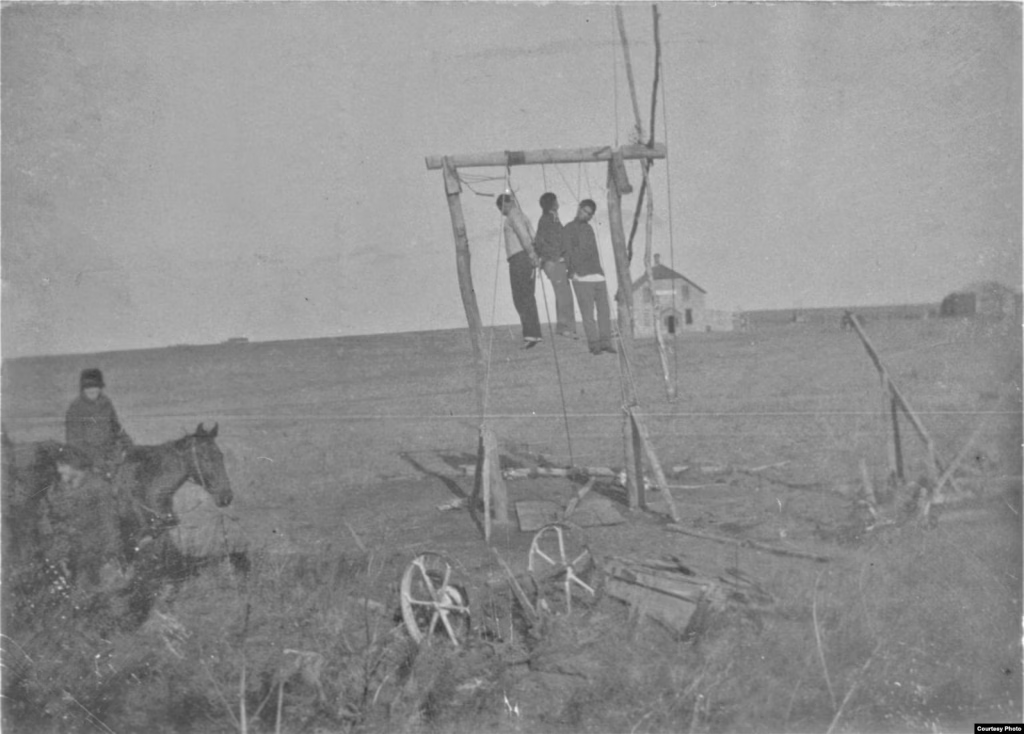
Their bodies were swinging to the breeze during all the day, the coroner not having arrived yet, and no one volunteering to cut them down.
St Paul Globe, Nov 15 1897
The county treasurer took a kodak picture of the bodies swinging from the windlass where they were allowed to remain until Sunday noon when the coroner arrived from Winona.
Grand Forks Daily Herald, November 23 1897
The bodies of Holy Track, Ireland and Coudot were crossed [over the Missouri] at this point Thursday night. The bodies were interred at Standing Rock. Coudot, being a Roman Catholic, was buried in the Roman Catholic Cemetery, and Holy Track and Ireland just outside the cemetery. Handsome double coffins were furnished for each of them, Coudot’s people dressed him in new clothes, and Major Cramsie [of the Indian Agency] furnished a handsome new outfit for Ireland and Holy Track out of his own pocket.
Dickinson Press, December 11 1897
Guy Corliss, Chief Justice of the North Dakota Supreme Court, denounced the lynching.
An innocent man was hanged by lynchers at Willlamsport. I have ample documentary proof of this. The Supreme Court ordered a new trial in Coudot’s case because it appeared that he was convicted on the uncorroborated evidence of Holytrack and Ireland, both of whom confessed to taking part in the murder of the Spicer family. Their statements as to Coudot were refuted by the testimony of Dr Ross, the resident agency physician at Standing Rock. Dr Ross’s veracity is unquestioned, and his testimony is supported by notes from his memorandum book. Another fact is that Holytrack and Ireland made two previous confessions, in neither of which did they implicate Coudot. Holytrack and Ireland were sure to have expiated their crime on the gallows, as there was no question of their guilt, but the mob made no distinction and hanged the innocent with the guilty. The lynching of Coudot is a foul crime and a blot on the fair name of the State, and his murderers should not go unpunished.
New York Times, November 17 1897
The community had no regrets.
All the moralizing and preaching that could be done between now and Doomsday would not convince the average citizen that the people of Emmons county were not justified in lynching the Indian fiends who murdered the Spicer family, and the only room for regret in the matter is that Blackhawk and Defender escaped the fate which overtook their fellow criminals.
The decision of the Supreme Court, which virtually meant the setting at liberty of the five wretches who massacred the Spicer family, may be in accord with the law, as its technicalities are construed by hired attorneys, but it is not Justice.
Emmons County Record, November 26 1897
Unsurprisingly, the Indians at Standing Rock were not happy about the lynchings.

Indians along the river and at Standing Rock are acting in a peculiar fashion and strange things are being said by them as to Winona, the town across the river from Yates, in which lived the Spicer family, murdered by Coudot and associates. The Indians are reported to say that some morning the people will wake up and find that there is no Winona there. The red men are supposed to be indignant at the lynching of Coudot. Settlers, who are scattered all over the country in the vicinity of Winona and along the river are not organized, but they feel that they would all be compelled to move away if Fort Yates is actually abandoned as is suggested by the war department.
Oakes Weekly Republican, December 17 1897
Denizens of Winona, the hamlet across the Missouri river opposite Standing Rock, are said to be living in terror, fearing attack from Indians in retaliation for the lynchings, and have hired a night watchman to give alarm in case of danger.
Grand Forks Daily Herald, December 16 1897
Since the only living witnesses had been lynched, there was no one left to testify against Black Hawk and Defender.
An interesting legal question is presented by yesterday’s lynching of three of the Spicer murderers. Two of the men, Holytrack and Ireland, were the State’s witnesses, and without their testimony the State has no case against the two surviving suspects, Black Hawk and Defender. There is, therefore, no possibility of convicting them before any tribunal, for the reason that the State’s witnesses, who were self-confessed accomplices of the murderers, are dead. At the coming term of Court, when the two men will be arraigned for trial, they must be dismissed.
New York Times, November 16 1897
Blackhawk and Defender have been discharged. The state’s principal witnesses, Holytrack and Ireland, being unavoidably beyond the jurisdiction of the court, and there being no likelihood of their leaving their present warm abode, at least during the present frigid weather, the State’s attorney moved to dismiss.
Emmons County Record, December 3 1897 (Darwin Streeter)
The charges were dismissed, and on December 1 they were released and escorted by an armed Indian guard to Standing Rock.

Frank Black Hawk, said to have been the man accused by his comrade, Coudot, in the shadow of the gibbet, of having been the leader of the five assassins who slaughtered six members of the Spicer family, and his comrade, George Defender, are free men, and on their way back to the Indian agency at Standing Rock under guard of forty Indians, all armed, to prevent any attempt on the part of a mob to lynch them.
Washburn Leader, December 25 1897

Exit All
Wauakiksin “George” Defender died of tuberculosis at Standing Rock in 1898, at the age of 30, survived by his wife Mary Pretends Eagle. He supposedly confessed on his deathbed, but there is no certainty that the newspaper account is truthful:
On his death bed he said that himself, Holy Track, Ireland and Coudot did the killing, and were to be assisted in the murderous attack by Black Hawk, but for some reason Black Hawk failed to meet them at the time fixed to proceed to the Spicer ranch, so they went without him. His statement throughout corroborated the confession of Holy Track and Ireland. It is further stated that his last words were, “Why didn’t they hang Black Hawk? Black Hawk is the man that got us into it.”
Bismarck Tribune, March 11 1898

Frank Black Hawk died of pneumonia at Fort Yates on March 28 1901.
Elizabeth’s husband William Rowse remarried, had a son, and lived until 1943. Her sister Ellen died of tuberculosis in 1911; her other sister Margaret lived until 1950.
Thomas’s brother John Spicer lived until 1944; his brother James (who stayed in Canada) lived until 1937.
Fort Yates was decommisioned in 1903. The town of Winona withered and died, and is no longer there; the graves of the Spicer family were unmarked and are now lost.
Holy Track is a main character in Ojibwe author Louise Erdrich’s 2008 novel Plague of Doves.

Sitting Bull’s son William joined Buffalo Bill’s Wild West Show, and killed Custer each night. He died in 1909 at the age of 31.

Sitting Bull’s nephew One Bull lived until 1947.
